Allpass Filter Sections
The allpass filter passes all frequencies with equal gain. This
is in contrast with a lowpass filter, which passes only low
frequencies, a highpass which passes high-frequencies, and a bandpass
filter which passes an interval of frequencies. An allpass filter may
have any phase response. The only requirement is that its amplitude
response be constant. Normally, this constant is
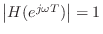 .
.
From a physical modeling point of view, a unity-gain allpass filter
models a lossless system in the sense
that it preserves signal energy. Specifically, if  denotes the input to an allpass filter
  , and if
  denotes
its output, then we have
denotes
its output, then we have
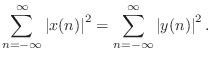
This equation says that the total energy out equals the total energy in. No energy was created or destroyed by the filter. All an allpass filter can do is delay the sinusoidal components of a signal by differing amounts.
Appendix C proves that Eq. (B.9) holds if and only if
 is lossless if and only if it is an allpass
filter having a gain of
is lossless if and only if it is an allpass
filter having a gain of  at every frequency
  .
.
The Biquad Allpass Section
The general biquad transfer function was given in Eq.(B.8) to be
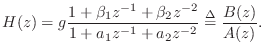
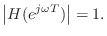
 , the numerator
  must be, in the
real case,B.3
must be, in the
real case,B.3

 ,
,
 , and
, and
 .
.
In terms of the poles and zeros of a filter
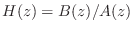 , an
allpass filter must have a zero at
, an
allpass filter must have a zero at  for each pole at
  .
That is if the denominator satisfies
.
That is if the denominator satisfies  , then the
numerator polynomial must satisfy
, then the
numerator polynomial must satisfy  . (Show this in
the one-pole case.) Therefore, defining
. (Show this in
the one-pole case.) Therefore, defining
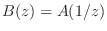 takes care of
this property for all roots of (all poles). However, since we
prefer that be a polynomial in
takes care of
this property for all roots of (all poles). However, since we
prefer that be a polynomial in  , we define
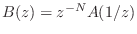 , where
  is the order of (the number of poles).
is then the flip of .
is the order of (the number of poles).
is then the flip of .
For further discussion and examples of allpass filters (including muli-input, multi-output allpass filters), see Appendix C. Analog allpass filters are defined and discussed in §E.8.
Allpass Filter Design
There is a fairly large literature thread on the topic of allpass filter design. Generally, they fall into two main categories: parametric and nonparametric methods. Parametric methods can produce allpass filters with optimal group-delay characteristics [42,41]. Nonparametric methods, while suboptimal, can design very large-order allpass filters, and errors can usually be made arbitrarily small by increasing the order [100,70,1], [78, pp. 60,172]. In music applications, it is usually the case that the ``optimality'' criterion is unknown because it depends on aspects of sound perception (see, for example, [35,72]). As a result, perceptually weighted nonparametric methods can often outperform optimal parametric methods in terms of cost/performance. For a nonparametric method that can design very high-order allpass filters according to highly flexible criteria, see [1].
Next Section:
DC Blocker
Previous Section:
Elementary Filter Sections