Analog Allpass Filters
It turns out that analog allpass filters are considerably simpler
mathematically than digital allpass filters (discussed in
§B.2). In fact, when working with digital allpass filters,
it can be fruitful to convert to the analog case using the bilinear
transform (§I.3.1), so that the filter may be manipulated in the
analog  plane rather than the digital
  plane. The analog case
is simpler because analog allpass filters may be described as having a
zero at
plane. The analog case
is simpler because analog allpass filters may be described as having a
zero at
 for every pole at
  , while digital allpass
filters must have a zero at
, while digital allpass
filters must have a zero at
 for every pole at
  .
In particular, the transfer function of every first-order analog
allpass filter can be written as
.
In particular, the transfer function of every first-order analog
allpass filter can be written as
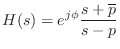
 is any constant phase offset.
To see why
is any constant phase offset.
To see why  must be allpass, note that
its frequency response is given by
must be allpass, note that
its frequency response is given by
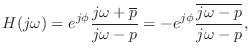
 (since
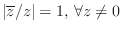 ). For real allpass filters,
complex poles must occur in conjugate pairs, so that the ``allpass
rule'' for poles and zeros may be simplified to state that a zero is
required at minus the location of every pole, i.e., every
real first-order allpass filter is of the form
). For real allpass filters,
complex poles must occur in conjugate pairs, so that the ``allpass
rule'' for poles and zeros may be simplified to state that a zero is
required at minus the location of every pole, i.e., every
real first-order allpass filter is of the form
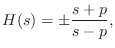

This simplified rule works because every complex pole
 is
accompanied by its conjugate
is
accompanied by its conjugate
 for some
 ![$ k\in[1:N]$](http://www.dsprelated.com/josimages_new/filters/img1918.png) .
.
Multiplying out the terms in Eq. (E.14), we find that the numerator
polynomial
(E.14), we find that the numerator
polynomial  is simply related to the denominator polynomial
  :
:
 must be in the left-half -plane for
stability, must be a Hurwitz polynomial, which implies
that all of its coefficients are nonnegative. The polynomial
must be in the left-half -plane for
stability, must be a Hurwitz polynomial, which implies
that all of its coefficients are nonnegative. The polynomial
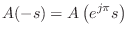
 -rotation of in the plane; therefore,
its roots must have non-positive real parts, and its coefficients form
an alternating sequence.
-rotation of in the plane; therefore,
its roots must have non-positive real parts, and its coefficients form
an alternating sequence.
As an example of the greater simplicity of analog allpass filters
relative to the discrete-time case, the graphical method for computing
phase response from poles and zeros (§8.3) gives immediately
that the phase response of every real analog allpass filter is equal
to twice the phase response of its numerator (plus when
the frequency response is negative at dc). This is because the angle
of a vector from a pole at to the point  along the
frequency axis is minus the angle of the vector from a zero at
along the
frequency axis is minus the angle of the vector from a zero at
 to the point
  .
.
Lossless Analog Filters
As discussed in §B.2, the an allpass filter can be defined
as any filter that preserves signal energy for every input
signal  . In the continuous-time case, this means

 denotes the output signal, and
 denotes the
L2 norm of
denotes the
L2 norm of  . Using the Rayleigh energy theorem
(Parseval's theorem) for Fourier transforms [87],
energy preservation can be expressed in the frequency domain by
. Using the Rayleigh energy theorem
(Parseval's theorem) for Fourier transforms [87],
energy preservation can be expressed in the frequency domain by

 and
and  denote the Fourier transforms of
  and , respectively,
and frequency-domain L2 norms are defined by
and , respectively,
and frequency-domain L2 norms are defined by
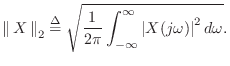
 denotes the impulse response of the allpass
filter, then its transfer function
is given by the Laplace transform of
denotes the impulse response of the allpass
filter, then its transfer function
is given by the Laplace transform of  ,
,
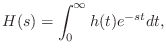
 , it must be
true in particular for complex sinusoidal inputs of the form
, it must be
true in particular for complex sinusoidal inputs of the form
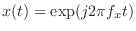 , in which case [87]
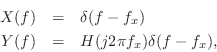
where  denotes the Dirac ``delta function'' or continuous
impulse function (§E.4.3). Thus, the allpass condition becomes
denotes the Dirac ``delta function'' or continuous
impulse function (§E.4.3). Thus, the allpass condition becomes


Suppose
 is a rational analog filter, so that
 and are polynomials in :

(We have normalized so that is monic ( ) without
loss of generality.) Equation (E.15) implies
) without
loss of generality.) Equation (E.15) implies

 , then the allpass condition reduces to
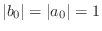 ,
which implies
,
which implies
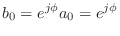 is any real phase constant. In other words,
 can be any unit-modulus complex number. If
  , then the
filter is allpass provided
, then the
filter is allpass provided
 , there are only two solutions:
 and
and  , in which case
 for all .
-
 and , i.e.,
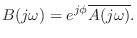
By analytic continuation, we have
 is real, then
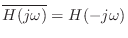 , and we can write

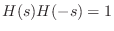 , every pole at in must be canceled
by a zero at in
, every pole at in must be canceled
by a zero at in  , which is a zero at in .
Thus, we have derived the simplified ``allpass rule'' for real analog
filters.
, which is a zero at in .
Thus, we have derived the simplified ``allpass rule'' for real analog
filters.
Next Section:
Introduction
Previous Section:
Quality Factor (Q)