







Analog Filters
For our purposes, an analog filter is any filter which operates
on continuous-time signals. In other respects, they are just
like digital filters. In particular, linear, time-invariant (LTI)
analog filters can be
characterized by their (continuous) impulse response  , where
  is time in seconds. Instead of a difference equation, analog filters
may be described by a differential equation. Instead of using
the z transform to compute the transfer function, we use the Laplace
transform (introduced in Appendix D). Every aspect of the theory
of digital filters has its counterpart in that of analog filters. In
fact, one can think of analog filters as simply the limiting case of
digital filters as the sampling-rate is allowed to go to infinity.
is time in seconds. Instead of a difference equation, analog filters
may be described by a differential equation. Instead of using
the z transform to compute the transfer function, we use the Laplace
transform (introduced in Appendix D). Every aspect of the theory
of digital filters has its counterpart in that of analog filters. In
fact, one can think of analog filters as simply the limiting case of
digital filters as the sampling-rate is allowed to go to infinity.
In the real world, analog filters are often electrical models, or ``analogues'', of mechanical systems working in continuous time. If the physical system is LTI (e.g., consisting of elastic springs and masses which are constant over time), an LTI analog filter can be used to model it. Before the widespread use of digital computers, physical systems were simulated on so-called ``analog computers.'' An analog computer was much like an analog synthesizer providing modular building-blocks (such as ``integrators'') that could be patched together to build models of dynamic systems.
Example Analog Filter
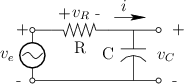
Figure E.1 shows a simple analog filter consisting of one resistor
( Ohms) and one capacitor (
 Farads). The voltages across these
elements are
Farads). The voltages across these
elements are  and
and  , respectively, where denotes
time in seconds. The filter input is the externally applied voltage
, respectively, where denotes
time in seconds. The filter input is the externally applied voltage
 , and the filter output is taken to be . By
Kirchoff's loop constraints [20], we have
, and the filter output is taken to be . By
Kirchoff's loop constraints [20], we have
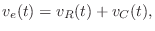
and the loop current is
 .
.
Capacitors
A capacitor can be made physically using two parallel conducting plates which are held close together (but not touching). Electric charge can be stored in a capacitor by applying a voltage across the plates.
The defining equation of a capacitor is

where
 denotes the capacitor's charge in Coulombs,
is the capacitance in Farads, and
denotes the capacitor's charge in Coulombs,
is the capacitance in Farads, and  is the
voltage drop across the capacitor in volts. Differentiating with
respect to time gives
is the
voltage drop across the capacitor in volts. Differentiating with
respect to time gives
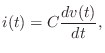
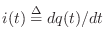 is now the current in
Amperes. Note that, by convention, the current is taken to be
positive when flowing from plus to minus across the capacitor (see the
arrow in Fig.E.1 which indicates the direction of current
flow--there is only one current flowing clockwise around the
loop formed by the voltage source, resistor, and capacitor when an
external voltage
is now the current in
Amperes. Note that, by convention, the current is taken to be
positive when flowing from plus to minus across the capacitor (see the
arrow in Fig.E.1 which indicates the direction of current
flow--there is only one current flowing clockwise around the
loop formed by the voltage source, resistor, and capacitor when an
external voltage  is applied).
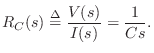
Taking the Laplace transform of both sides gives

Assuming a zero initial voltage across the capacitor at time 0, we have
 Ohms.
Ohms.
Mechanical Equivalent of a Capacitor is a Spring
The mechanical analog of a capacitor is the compliance of a
spring. The voltage across a capacitor corresponds to the
force  used to displace a spring. The charge stored in
the capacitor corresponds to the displacement
used to displace a spring. The charge stored in
the capacitor corresponds to the displacement  of the spring.
Thus, Eq.
of the spring.
Thus, Eq. (E.2) corresponds to Hooke's law for ideal springs:

 is called the spring constant or
spring stiffness.
Note that Hooke's law is usually written as
is called the spring constant or
spring stiffness.
Note that Hooke's law is usually written as
 . The quantity
  is called the
spring compliance.
is called the
spring compliance.
Inductors
 , output
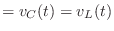 .
.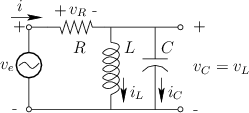
An inductor can be made physically using a coil of wire, and it
stores magnetic flux when a current flows through it. Figure E.2
shows a circuit in which a resistor is in series with the parallel
combination of a capacitor and inductor  .
.
The defining equation of an inductor is

where
 denotes the inductor's stored magnetic flux at time
, is the inductance in Henrys (H), and is the
current through the inductor coil in Amperes (A), where
an Ampere is a Coulomb (of electric charge) per second.
Differentiating with respect to time gives
denotes the inductor's stored magnetic flux at time
, is the inductance in Henrys (H), and is the
current through the inductor coil in Amperes (A), where
an Ampere is a Coulomb (of electric charge) per second.
Differentiating with respect to time gives
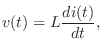
where
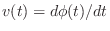 is the voltage across the inductor in
volts. Again, the current is taken to be positive when flowing
from plus to minus through the inductor.
is the voltage across the inductor in
volts. Again, the current is taken to be positive when flowing
from plus to minus through the inductor.
Taking the Laplace transform of both sides gives

Assuming a zero initial current in the inductor at time 0, we have
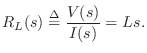
 .
Like the capacitor, it can be analyzed in steady state (initial
conditions neglected) as a simple resistor with value Ohms.
.
Like the capacitor, it can be analyzed in steady state (initial
conditions neglected) as a simple resistor with value Ohms.
Mechanical Equivalent of an Inductor is a Mass
The mechanical analog of an inductor is a mass. The voltage
across an inductor corresponds to the force used to
accelerate a mass  . The current through in the inductor
corresponds to the velocity
. The current through in the inductor
corresponds to the velocity
 of the mass. Thus,
Eq.(E.4) corresponds to Newton's second law for an ideal mass:
of the mass. Thus,
Eq.(E.4) corresponds to Newton's second law for an ideal mass:

 denotes the acceleration of the mass .
From the defining equation  for an inductor [Eq.(E.3)], we
see that the stored magnetic flux in an inductor is analogous to mass
times velocity, or momentum. In other words, magnetic flux may
be regarded as electric-charge momentum.
for an inductor [Eq.(E.3)], we
see that the stored magnetic flux in an inductor is analogous to mass
times velocity, or momentum. In other words, magnetic flux may
be regarded as electric-charge momentum.
RC Filter Analysis
Referring again to Fig.E.1, let's perform an impedance analysis of the simple RC lowpass filter.
Driving Point Impedance
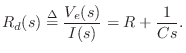
Taking the Laplace transform of both sides of Eq.(E.1) gives
 , as derived above. The driving point impedance of the whole
RC filter is thus
, as derived above. The driving point impedance of the whole
RC filter is thus
Transfer Function
Since the input and output signals are defined as and
, respectively, the transfer function of this analog
filter is given by, using voltage divider rule,

 is called the RC time constant,
for reasons we will soon see.
is called the RC time constant,
for reasons we will soon see.
Impulse Response
In the same way that the impulse response of a digital filter is given by the inverse z transform of its transfer function, the impulse response of an analog filter is given by the inverse Laplace transform of its transfer function, viz.,

 denotes the Heaviside unit step function
![$\displaystyle u(t) \isdef \left\{\begin{array}{ll}
1, & t\geq 0 \\ [5pt]
0, & t<0. \\
\end{array}\right.
$](http://www.dsprelated.com/josimages_new/filters/img1814.png)
 :
:
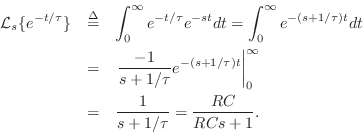
In more complicated situations, any rational  (ratio of
polynomials in
(ratio of
polynomials in  ) may be expanded into first-order terms by means of
a partial fraction expansion (see §6.8) and each term in
the expansion inverted by inspection as above.
) may be expanded into first-order terms by means of
a partial fraction expansion (see §6.8) and each term in
the expansion inverted by inspection as above.
The Continuous-Time Impulse
The continuous-time impulse response was derived above as the inverse-Laplace transform of the transfer function. In this section, we look at how the impulse itself must be defined in the continuous-time case.
An impulse in continuous time may be loosely defined as any ``generalized function'' having ``zero width'' and unit area under it. A simple valid definition is
![$\displaystyle \delta(t) \isdef \lim_{\Delta \to 0} \left\{\begin{array}{ll} \fr...
...eq t\leq \Delta \\ [5pt] 0, & \hbox{otherwise}. \\ \end{array} \right. \protect$](http://www.dsprelated.com/josimages_new/filters/img1818.png)
More generally, an impulse can be defined as the limit of any pulse shape which maintains unit area and approaches zero width at time 0. As a result, the impulse under every definition has the so-called sifting property under integration,
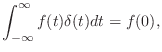
provided
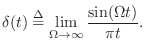
is continuous at  . This is often taken as the
defining property of an impulse, allowing it to be defined in terms
of non-vanishing function limits such as
. This is often taken as the
defining property of an impulse, allowing it to be defined in terms
of non-vanishing function limits such as
Poles and Zeros
In the simple RC-filter example of §E.4.3, the transfer function is
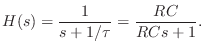
 , and we can say
there is one zero at infinity as well. Since resistors and
capacitors always have positive values, the time constant
, and we can say
there is one zero at infinity as well. Since resistors and
capacitors always have positive values, the time constant  is always non-negative. This means the impulse response is always an
exponential decay--never a growth. Since the pole is at
is always non-negative. This means the impulse response is always an
exponential decay--never a growth. Since the pole is at
 , we find that it is always in the left-half
plane. This turns out to be the case also for any complex
analog one-pole filter. By consideration of the partial fraction
expansion of any , it is clear that, for stability of an analog
filter, all poles must lie in the left half of the complex
plane. This is the analog counterpart of the requirement for digital
filters that all poles lie inside the unit circle.
, we find that it is always in the left-half
plane. This turns out to be the case also for any complex
analog one-pole filter. By consideration of the partial fraction
expansion of any , it is clear that, for stability of an analog
filter, all poles must lie in the left half of the complex
plane. This is the analog counterpart of the requirement for digital
filters that all poles lie inside the unit circle.
RLC Filter Analysis
Referring now to Fig.E.2, let's perform an impedance analysis of that RLC network.
Driving Point Impedance
By inspection, we can write

 denotes ``in parallel with,'' and we used the general formula,
memorized by any electrical engineering student,
denotes ``in parallel with,'' and we used the general formula,
memorized by any electrical engineering student,
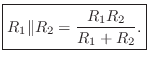
 and
and  is given by the product divided by the sum
of the impedances.
is given by the product divided by the sum
of the impedances.
Transfer Function
The transfer function in this example can similarly be found using voltage divider rule:

Poles and Zeros
From the quadratic formula, the two poles are located at

 and another at
  . If the
damping is sufficienly small so that
. If the
damping is sufficienly small so that
 , then
the poles form a complex-conjugate pair:
, then
the poles form a complex-conjugate pair:
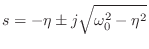
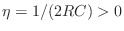 , the poles are always in the left-half
plane, and hence the analog RLC filter is always stable. When the
damping is zero, the poles go to the
, the poles are always in the left-half
plane, and hence the analog RLC filter is always stable. When the
damping is zero, the poles go to the  axis:
axis:

Impulse Response
The impulse response is again the inverse Laplace transform of the
transfer function. Expanding into a sum of complex one-pole
sections,

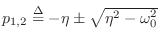 .
Equating numerator coefficients gives
.
Equating numerator coefficients gives
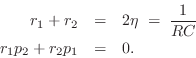
This pair of equations in two unknowns may be solved for  and
and  .
The impulse response is then
.
The impulse response is then

Relating Pole Radius to Bandwidth
Consider the continuous-time complex one-pole
resonator with -plane transfer function
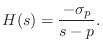
 is the Laplace-transform variable, and
 is the single complex pole. The numerator scaling
has been set to
is the single complex pole. The numerator scaling
has been set to  so that the frequency response is normalized to
unity gain at resonance:
so that the frequency response is normalized to
unity gain at resonance:


 , since changing
  merely translates the amplitude response with respect to
  .
(We could alternatively define the translated frequency variable
.
(We could alternatively define the translated frequency variable
 to get the same simplification.) The squared amplitude response is now
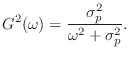
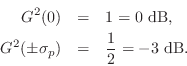
This shows that the 3-dB bandwidth of the resonator in radians
per second is
 , or twice the absolute value of the real
part of the pole. Denoting the 3-dB bandwidth in Hz by
, or twice the absolute value of the real
part of the pole. Denoting the 3-dB bandwidth in Hz by  , we have
derived the relation
, we have
derived the relation
 , or
, or
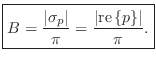
 dB attenuation is the same thing as a power scaling by
 , the 3-dB bandwidth is also called the half-power
bandwidth.
, the 3-dB bandwidth is also called the half-power
bandwidth.
It now remains to ``digitize'' the continuous-time resonator and show
that relation Eq.(8.7) follows. The most natural mapping of the
plane to the  plane is

 is the sampling period. This mapping follows directly from
sampling the Laplace transform to obtain the z transform. It is
also called the impulse invariant transformation [68, pp.
216-219], and for digital poles it is the same as the
matched z transformation [68, pp. 224-226].
Applying the matched z transformation to the pole
is the sampling period. This mapping follows directly from
sampling the Laplace transform to obtain the z transform. It is
also called the impulse invariant transformation [68, pp.
216-219], and for digital poles it is the same as the
matched z transformation [68, pp. 224-226].
Applying the matched z transformation to the pole  in the
plane gives the digital pole
in the
plane gives the digital pole

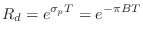
 and analog 3-dB bandwidth
(in Hz) is now shown. Since the mapping
and analog 3-dB bandwidth
(in Hz) is now shown. Since the mapping
 becomes
exact as
becomes
exact as  , we have that is also the 3-dB bandwidth of the
digital resonator in the limit as the sampling rate approaches
infinity. In practice, it is a good approximate relation whenever the
digital pole is close to the unit circle (
, we have that is also the 3-dB bandwidth of the
digital resonator in the limit as the sampling rate approaches
infinity. In practice, it is a good approximate relation whenever the
digital pole is close to the unit circle (
 ).
).
Quality Factor (Q)
The quality factor (Q) of a two-pole resonator is defined by [20, p. 184]

where
 and
and  are parameters of the resonator transfer
function
are parameters of the resonator transfer
function
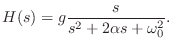
Note that Q is defined in the context of continuous-time resonators, so the transfer function
is the Laplace transform
(instead of the z transform) of the continuous (instead of
discrete-time) impulse-response . An introduction to
Laplace-transform analysis appears in Appendix D. The parameter
is called the damping constant (or ``damping factor'')
of the second-order transfer function, and is called the
resonant frequency [20, p. 179].
The resonant frequency coincides with the physical
oscillation frequency of the resonator impulse response when the
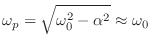
damping constant is zero. For light damping, is
approximately the physical frequency of impulse-response oscillation
( times the zero-crossing rate of sinusoidal oscillation under
an exponential decay). For larger damping constants, it is better to
use the imaginary part of the pole location as a definition of
resonance frequency (which is exact in the case of a single complex
pole). (See §B.6 for a more complete discussion of resonators,
in the discrete-time case.)
times the zero-crossing rate of sinusoidal oscillation under
an exponential decay). For larger damping constants, it is better to
use the imaginary part of the pole location as a definition of
resonance frequency (which is exact in the case of a single complex
pole). (See §B.6 for a more complete discussion of resonators,
in the discrete-time case.)
By the quadratic formula, the poles of the transfer function
are given by
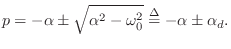
Therefore, the poles are complex only when
 . Since real poles
do not resonate, we have for any resonator. The case
. Since real poles
do not resonate, we have for any resonator. The case  is called critically damped, while
  is called
overdamped. A resonator () is said to be
underdamped, and the limiting case
is called
overdamped. A resonator () is said to be
underdamped, and the limiting case  is simply
undamped.
is simply
undamped.
Relating to the notation of the previous section, in which we defined
one of the complex poles as
, we have
 |
 |
 |
(E.10) |
 |
|
 |
(E.11) |
For resonators,
coincides with the classically defined
quantity [20, p. 624]
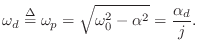
Since the imaginary parts of the complex resonator poles are
 , the zero-crossing rate of the resonator impulse
response is
, the zero-crossing rate of the resonator impulse
response is
 crossings per second. Moreover,
  is very close to the peak-magnitude frequency in the resonator
amplitude response. If we eliminate the negative-frequency pole,
becomes exactly the peak frequency. In other
words, as a measure of resonance peak frequency, only
neglects the interaction of the positive- and negative-frequency
resonance peaks in the frequency response, which is usually negligible
except for highly damped, low-frequency resonators. For any amount of
damping
gives the impulse-response zero-crossing rate
exactly, as is immediately seen from the derivation in the next
section.
is very close to the peak-magnitude frequency in the resonator
amplitude response. If we eliminate the negative-frequency pole,
becomes exactly the peak frequency. In other
words, as a measure of resonance peak frequency, only
neglects the interaction of the positive- and negative-frequency
resonance peaks in the frequency response, which is usually negligible
except for highly damped, low-frequency resonators. For any amount of
damping
gives the impulse-response zero-crossing rate
exactly, as is immediately seen from the derivation in the next
section.
Decay Time is Q Periods
Another well known rule of thumb is that the  of a resonator is the
number of ``periods'' under the exponential decay of its impulse
response. More precisely, we will show that, for
of a resonator is the
number of ``periods'' under the exponential decay of its impulse
response. More precisely, we will show that, for  , the
impulse response decays by the factor
, the
impulse response decays by the factor  in cycles, which
is about 96 percent decay, or -27 dB.
in cycles, which
is about 96 percent decay, or -27 dB.
The impulse response corresponding to Eq.(E.8) is found by
inverting the Laplace transform of the transfer function . Since it
is only second order, the solution can be found in many tables of
Laplace transforms. Alternatively, we can break it up into a sum of
first-order terms which are invertible by inspection (possibly after
rederiving the Laplace transform of an exponential decay, which is
very simple). Thus we perform the partial fraction expansion of
Eq.(E.8) to obtain
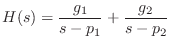
 are given by Eq.(E.9), and some algebra gives
 |
|
 |
(E.12) |
 |
|
 |
(E.13) |
as the respective residues of the poles
.
The impulse response is thus
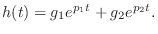
Assuming a resonator, , we have
 , where
 (using notation of the
preceding section), and the impulse response reduces to
(using notation of the
preceding section), and the impulse response reduces to

 and
and  are overall amplitude and phase constants,
respectively.E.1
are overall amplitude and phase constants,
respectively.E.1
We have shown so far that the impulse response decays as
 with a sinusoidal radian frequency
 under the exponential envelope. After Q periods at frequency
, time has advanced to
under the exponential envelope. After Q periods at frequency
, time has advanced to
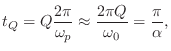 (E.7)
(E.7)
 .
Thus, after periods, the amplitude envelope has decayed to
.
Thus, after periods, the amplitude envelope has decayed to

 , or .
Q as Energy Stored over Energy Dissipated
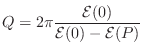
Yet another meaning for is as follows [20, p. 326]

Proof. The total stored energy at time is
equal to the total energy of the remaining response. After an impulse
at time 0, the stored energy in a second-order resonator is

 is
is
 , where
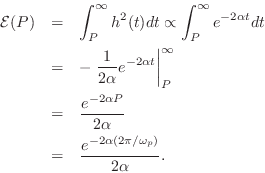
Assuming as before,
 so that
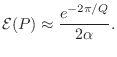
 , we obtain

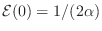 , gives
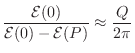
 , while
the one of the previous section only required .
, while
the one of the previous section only required .
Analog Allpass Filters
It turns out that analog allpass filters are considerably simpler
mathematically than digital allpass filters (discussed in
§B.2). In fact, when working with digital allpass filters,
it can be fruitful to convert to the analog case using the bilinear
transform (§I.3.1), so that the filter may be manipulated in the
analog plane rather than the digital plane. The analog case
is simpler because analog allpass filters may be described as having a
zero at
 for every pole at
  , while digital allpass
filters must have a zero at
, while digital allpass
filters must have a zero at
 for every pole at
  .
In particular, the transfer function of every first-order analog
allpass filter can be written as
.
In particular, the transfer function of every first-order analog
allpass filter can be written as
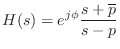
 is any constant phase offset.
To see why must be allpass, note that
its frequency response is given by
is any constant phase offset.
To see why must be allpass, note that
its frequency response is given by
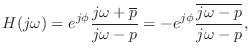 (since
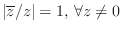 ). For real allpass filters,
complex poles must occur in conjugate pairs, so that the ``allpass
rule'' for poles and zeros may be simplified to state that a zero is
required at minus the location of every pole, i.e., every
real first-order allpass filter is of the form
). For real allpass filters,
complex poles must occur in conjugate pairs, so that the ``allpass
rule'' for poles and zeros may be simplified to state that a zero is
required at minus the location of every pole, i.e., every
real first-order allpass filter is of the form
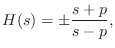

This simplified rule works because every complex pole
is
accompanied by its conjugate
 for some
 ![$ k\in[1:N]$](http://www.dsprelated.com/josimages_new/filters/img1918.png) .
.
Multiplying out the terms in Eq.(E.14), we find that the numerator
polynomial  is simply related to the denominator polynomial
  :
:
 must be in the left-half -plane for
stability, must be a Hurwitz polynomial, which implies
that all of its coefficients are nonnegative. The polynomial
must be in the left-half -plane for
stability, must be a Hurwitz polynomial, which implies
that all of its coefficients are nonnegative. The polynomial
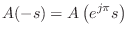
 -rotation of in the plane; therefore,
its roots must have non-positive real parts, and its coefficients form
an alternating sequence.
-rotation of in the plane; therefore,
its roots must have non-positive real parts, and its coefficients form
an alternating sequence.
As an example of the greater simplicity of analog allpass filters
relative to the discrete-time case, the graphical method for computing
phase response from poles and zeros (§8.3) gives immediately
that the phase response of every real analog allpass filter is equal
to twice the phase response of its numerator (plus when
the frequency response is negative at dc). This is because the angle
of a vector from a pole at to the point  along the
frequency axis is minus the angle of the vector from a zero at
along the
frequency axis is minus the angle of the vector from a zero at
 to the point .
Lossless Analog Filters
As discussed in §B.2, the an allpass filter can be defined
as any filter that preserves signal energy for every input
signal . In the continuous-time case, this means

 denotes the output signal, and
 denotes the
L2 norm of
denotes the
L2 norm of  . Using the Rayleigh energy theorem
(Parseval's theorem) for Fourier transforms [87],
energy preservation can be expressed in the frequency domain by
. Using the Rayleigh energy theorem
(Parseval's theorem) for Fourier transforms [87],
energy preservation can be expressed in the frequency domain by

 and
and  denote the Fourier transforms of
  and , respectively,
and frequency-domain L2 norms are defined by
and , respectively,
and frequency-domain L2 norms are defined by
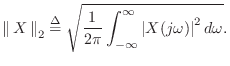 denotes the impulse response of the allpass
filter, then its transfer function
is given by the Laplace transform of
denotes the impulse response of the allpass
filter, then its transfer function
is given by the Laplace transform of  ,
,
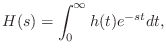
 , it must be
true in particular for complex sinusoidal inputs of the form
, it must be
true in particular for complex sinusoidal inputs of the form
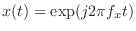 , in which case [87]
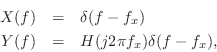
where  denotes the Dirac ``delta function'' or continuous
impulse function (§E.4.3). Thus, the allpass condition becomes
denotes the Dirac ``delta function'' or continuous
impulse function (§E.4.3). Thus, the allpass condition becomes


Suppose
 is a rational analog filter, so that
 and are polynomials in :

(We have normalized so that is monic ( ) without
loss of generality.) Equation (E.15) implies
) without
loss of generality.) Equation (E.15) implies

 , then the allpass condition reduces to
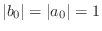 ,
which implies
,
which implies
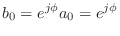 is any real phase constant. In other words,
 can be any unit-modulus complex number. If
  , then the
filter is allpass provided
, then the
filter is allpass provided
 , there are only two solutions:
 and
and  , in which case
 for all .
-
 and , i.e.,
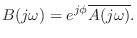
By analytic continuation, we have
 is real, then
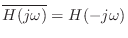 , and we can write

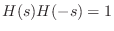 , every pole at in must be canceled
by a zero at in
, every pole at in must be canceled
by a zero at in  , which is a zero at in .
Thus, we have derived the simplified ``allpass rule'' for real analog
filters.
, which is a zero at in .
Thus, we have derived the simplified ``allpass rule'' for real analog
filters.
Next Section:
Matrix Filter Representations
Previous Section:
Introduction to Laplace Transform Analysis












