The BiQuad Section
The term ``biquad'' is short for ``bi-quadratic'', and is a common name for a two-pole, two-zero digital filter. The transfer function of the biquad can be defined as
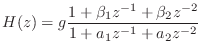
where
 can be called the overall gain of the biquad. Since
both the numerator and denominator of this transfer function are
quadratic polynomials in
can be called the overall gain of the biquad. Since
both the numerator and denominator of this transfer function are
quadratic polynomials in  (or
(or  ), the transfer function is said
to be ``bi-quadratic'' in (or ).
), the transfer function is said
to be ``bi-quadratic'' in (or ).
As derived in §B.1.3, for real second-order polynomials having
complex roots, it is often convenient to express the polynomial
coefficients in terms of the radius  and angle
  of the
positive-frequency pole. For example, denoting the denominator
polynomial by
of the
positive-frequency pole. For example, denoting the denominator
polynomial by
 , we have
 as the resonance frequency (in
radians per sample--
as the resonance frequency (in
radians per sample--
 , where
  is the resonance
frequency in Hz), and determines the ``Q'' of the resonance (see
§B.1.3). The numerator is less often represented in this way,
but when it is, we may think of the zero-angle as the
antiresonance frequency, and the zero-radius affects the
depth and width of the antiresonance (or notch).
is the resonance
frequency in Hz), and determines the ``Q'' of the resonance (see
§B.1.3). The numerator is less often represented in this way,
but when it is, we may think of the zero-angle as the
antiresonance frequency, and the zero-radius affects the
depth and width of the antiresonance (or notch).
As discussed on page ![[*]](../icons/crossref.png) , a common setting for the zeros when
making a resonator is to place one at
, a common setting for the zeros when
making a resonator is to place one at  (dc) and the other at
 (half the sampling rate), i.e.,
  and
and
 in
Eq.
in
Eq. (B.8) above
 .
This zero placement normalizes the peak gain of the resonator if it is
swept using the
.
This zero placement normalizes the peak gain of the resonator if it is
swept using the  parameter.
Using the shift theorem for z transforms, the difference equation for the biquad can be written by inspection of the transfer function as
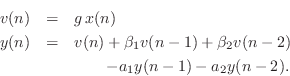
where  denotes the input signal sample at time
  , and
, and  is the output signal. This is the form that is typically implemented
in software. It is essentially the direct-form I implementation. (To obtain the official
direct-form I structure, the overall gain must be not be pulled
out separately, resulting in feedforward coefficients
is the output signal. This is the form that is typically implemented
in software. It is essentially the direct-form I implementation. (To obtain the official
direct-form I structure, the overall gain must be not be pulled
out separately, resulting in feedforward coefficients
![$ [g,g\beta_1,g\beta_2]$](http://www.dsprelated.com/josimages_new/filters/img1435.png) instead. See Chapter 9 for more about
filter implementation forms.)
instead. See Chapter 9 for more about
filter implementation forms.)
Next Section:
Biquad Software Implementations
Previous Section:
Complex Resonator