Butterworth Lowpass Poles and Zeros
When the maximally flat optimality criterion is applied to the general
(analog) squared amplitude response
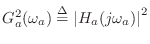 , a surprisingly simple
result is obtained [64]:
, a surprisingly simple
result is obtained [64]:
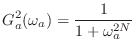
where
 is the desired order (number of poles). This simple result
is obtained when the response is taken to be maximally flat at
is the desired order (number of poles). This simple result
is obtained when the response is taken to be maximally flat at
 as well as dc (i.e., when both
 and
and
 are maximally flat at dc).I.1Also, an arbitrary scale factor for
  has been set such that
the cut-off frequency (-3dB frequency) is
has been set such that
the cut-off frequency (-3dB frequency) is
 rad/sec.
The analytic continuation
(§D.2)
of
to the whole
 -plane may be obtained by substituting
 to obtain

 poles of this expression are simply the roots of unity when
is odd, and the roots of
poles of this expression are simply the roots of unity when
is odd, and the roots of  when is even. Half of these
poles
when is even. Half of these
poles  are in the left-half -plane (
re
are in the left-half -plane (
re ) and
thus belong to
) and
thus belong to  (which must be stable). The other half belong
to
(which must be stable). The other half belong
to  . In summary, the poles of an th-order Butterworth
lowpass prototype are located in the -plane at
. In summary, the poles of an th-order Butterworth
lowpass prototype are located in the -plane at
 , where [64, p. 168]
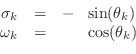
with
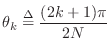
 . These poles may be quickly found graphically
by placing poles uniformly distributed around the unit circle (in
the plane, not the
. These poles may be quickly found graphically
by placing poles uniformly distributed around the unit circle (in
the plane, not the  plane--this is not a frequency axis) in
such a way that each complex pole has a complex-conjugate counterpart.
plane--this is not a frequency axis) in
such a way that each complex pole has a complex-conjugate counterpart.
A Butterworth lowpass filter additionally has zeros at  .
Under the bilinear transform
.
Under the bilinear transform
 , these all map to the
point
, these all map to the
point  , which determines the numerator of the digital filter as
 .
.
Given the poles and zeros of the analog prototype, it is straightforward to convert to digital form by means of the bilinear transformation.
Next Section:
Example: Second-Order Butterworth Lowpass
Previous Section:
Mechanical Equivalent of an Inductor is a Mass