







Complex Resonator
Normally when we need a resonator, we think immediately of the two-pole resonator. However, there is also a complex one-pole resonator having the transfer function
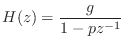
where
 is the single complex pole, and
  is a
scale factor. In the time domain, the complex one-pole resonator is
implemented as
is a
scale factor. In the time domain, the complex one-pole resonator is
implemented as

 is complex, the output
  is generally complex even when
the input
is generally complex even when
the input  is real.
Since the impulse response is the inverse z transform of the
transfer function, we can write down the impulse response of the
complex one-pole resonator by recognizing Eq. (B.6) as the
closed-form sum of an infinite geometric series, yielding
(B.6) as the
closed-form sum of an infinite geometric series, yielding
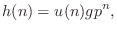
 denotes the unit step function:
![$\displaystyle u(n) \isdef \left\{\begin{array}{ll}
1, & n\geq 0 \\ [5pt]
0, & n<0 \\
\end{array}\right.
$](http://www.dsprelated.com/josimages_new/filters/img1406.png) times the
geometric sequence
times the
geometric sequence  with the pole as its ``term ratio''. In
general,
with the pole as its ``term ratio''. In
general,
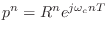 is a sampled, exponentially
decaying sinusoid at radian frequency
is a sampled, exponentially
decaying sinusoid at radian frequency
 . By
setting somewhere on the unit circle to get
. By
setting somewhere on the unit circle to get

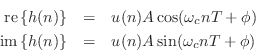
 rad/sec. If we like, we can extract the real and imaginary
parts separately to create both a sine-wave and a cosine-wave output:
rad/sec. If we like, we can extract the real and imaginary
parts separately to create both a sine-wave and a cosine-wave output:
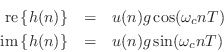
These may be called phase-quadrature sinusoids, since their phases differ by 90 degrees. The phase quadrature relationship for two sinusoids means that they can be regarded as the real and imaginary parts of a complex sinusoid.
By allowing to be complex,

The frequency response of the complex one-pole resonator differs from
that of the two-pole real resonator in that the resonance
occurs only for one positive or negative frequency , but not
both. As a result, the resonance frequency is also the
frequency where the peak-gain occurs; this is only true in
general for the complex one-pole resonator. In particular, the peak
gain of a real two-pole filter does not occur exactly at resonance, except
when
 ,
,  , or
, or  . See
§B.6 for more on peak-gain versus resonance-gain (and how to
normalize them in practice).
. See
§B.6 for more on peak-gain versus resonance-gain (and how to
normalize them in practice).
Two-Pole Partial Fraction Expansion
Note that every real two-pole resonator can be broken up into a sum of two complex one-pole resonators:

where
 and
and  are constants (generally complex). In this
``parallel one-pole'' form, it can be seen that the peak gain is no
longer equal to the resonance gain, since each one-pole frequency
response is ``tilted'' near resonance by being summed with the
``skirt'' of the other one-pole resonator, as illustrated in
Fig.B.9. This interaction between the positive- and negative-frequency
poles is minimized by making the resonance sharper (
are constants (generally complex). In this
``parallel one-pole'' form, it can be seen that the peak gain is no
longer equal to the resonance gain, since each one-pole frequency
response is ``tilted'' near resonance by being summed with the
``skirt'' of the other one-pole resonator, as illustrated in
Fig.B.9. This interaction between the positive- and negative-frequency
poles is minimized by making the resonance sharper (
 ),
and by separating the pole frequencies
),
and by separating the pole frequencies
 . The
greatest separation occurs when the resonance frequency is at
one-fourth the sampling rate (
. The
greatest separation occurs when the resonance frequency is at
one-fourth the sampling rate (
 ). However,
low-frequency resonances, which are by far the most common in audio
work, suffer from significant overlapping of the positive- and
negative-frequency poles.
). However,
low-frequency resonances, which are by far the most common in audio
work, suffer from significant overlapping of the positive- and
negative-frequency poles.
![\includegraphics[width=\twidth ]{eps/tppfe}](http://www.dsprelated.com/josimages_new/filters/img1419.png) |
 ,
, and
and
 , overlaid with the
frequency responses (dashed lines) of its positive- and
negative-frequency complex one-pole components. Also marked (dashed
lines) are the two resonance frequencies; the peak frequencies can be
seen to lie slightly outside the resonance frequencies.
, overlaid with the
frequency responses (dashed lines) of its positive- and
negative-frequency complex one-pole components. Also marked (dashed
lines) are the two resonance frequencies; the peak frequencies can be
seen to lie slightly outside the resonance frequencies.
To show Eq.(B.7) is always true, let's solve in general for
and given and . Recombining the right-hand side
over a common denominator and equating numerators gives

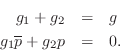
The solution is easily found to be
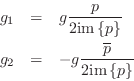
where we have assumed
im , as necessary to have a
resonator in the first place.
, as necessary to have a
resonator in the first place.
Breaking up the two-pole real resonator into a parallel sum of two complex one-pole resonators is a simple example of a partial fraction expansion (PFE) (discussed more fully in §6.8).
Note that the inverse z transform of a sum of one-pole transfer
functions can be easily written down by inspection. In particular,
the impulse response of the PFE of the two-pole resonator (see
Eq.(B.7)) is clearly

 is real, we must have
 , as we found above
without assuming it. If
, as we found above
without assuming it. If
 , then is a real sinusoid
created by the sum of two complex sinusoids spinning in opposite
directions on the unit circle.
, then is a real sinusoid
created by the sum of two complex sinusoids spinning in opposite
directions on the unit circle.
Next Section:
The BiQuad Section
Previous Section:
Two-Zero












