Cyclic Convolution Matrix
An infinite Toeplitz matrix implements, in principle, acyclic
convolution (which is what we normally mean when we just say
``convolution''). In practice, the convolution of a signal  and an
impulse response
and an
impulse response  , in which both and are more than a
hundred or so samples long, is typically implemented fastest using
FFT convolution (i.e., performing fast convolution using the
Fast Fourier Transform (FFT)
[84]F.3). However, the FFT computes
cyclic convolution unless sufficient zero padding is used
[84]. The matrix representation of cyclic (or ``circular'')
convolution is a circulant matrix, e.g.,
, in which both and are more than a
hundred or so samples long, is typically implemented fastest using
FFT convolution (i.e., performing fast convolution using the
Fast Fourier Transform (FFT)
[84]F.3). However, the FFT computes
cyclic convolution unless sufficient zero padding is used
[84]. The matrix representation of cyclic (or ``circular'')
convolution is a circulant matrix, e.g.,
![$\displaystyle \mathbf{h}= \left[\begin{array}{cccccc}
h_0 & 0 & 0 & 0 & h_2 & ...
... h_2 & h_1 & h_0 & 0 \\ [2pt]
0 & 0 & 0 & h_2 & h_1 & h_0
\end{array}\right].
$](http://www.dsprelated.com/josimages_new/filters/img1979.png)
 circulant matrix are the DFT sinusoids
for a length
circulant matrix are the DFT sinusoids
for a length  DFT [84]. Similarly, the eigenvalues may be
found by simply taking the DFT of the first row.
DFT [84]. Similarly, the eigenvalues may be
found by simply taking the DFT of the first row.
The DFT eigenstructure of circulant matrices is directly related to
the DFT convolution theorem [84]. The above  circulant matrix
 , when multiplied times a length 6 vector
 ,
implements cyclic convolution of
with
,
implements cyclic convolution of
with
![$ \underline{h}=[h_0,h_1,h_3,0,0,0]$](http://www.dsprelated.com/josimages_new/filters/img1981.png) .
Using the DFT to perform the circular convolution can be expressed as
.
Using the DFT to perform the circular convolution can be expressed as
 IDFT
IDFT DFT
DFT DFT
DFT
 ' denotes circular convolution. Let
 denote
the matrix of sampled DFT sinusoids for a length DFT:
denote
the matrix of sampled DFT sinusoids for a length DFT:
![$ \mathbf{S}[k,n]\isdeftext e^{j2\pi k n/N}$](http://www.dsprelated.com/josimages_new/filters/img1988.png) . Then
. Then
 is the
DFT matrix, where `
is the
DFT matrix, where ` ' denotes Hermitian transposition
(transposition and complex-conjugation). The DFT of the length-
vector
can be written as
' denotes Hermitian transposition
(transposition and complex-conjugation). The DFT of the length-
vector
can be written as
 , and the
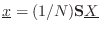
corresponding inverse DFT is
, and the
corresponding inverse DFT is
 . The
DFT-eigenstructure of circulant matrices provides that a real circulant matrix
having top row
. The
DFT-eigenstructure of circulant matrices provides that a real circulant matrix
having top row
 satisfies
 diag
diag , where
 is the length
DFT of
is the length
DFT of
 , and
diag denotes a diagonal matrix with the
elements of
, and
diag denotes a diagonal matrix with the
elements of
 along the diagonal. Therefore,
diag
along the diagonal. Therefore,
diag . By the DFT
convolution theorem,
. By the DFT
convolution theorem,

Premultiplying by the IDFT matrix
 yields
 has eigenvalues
and eigenvectors given
by the columns of
(the DFT sinusoids).
has eigenvalues
and eigenvectors given
by the columns of
(the DFT sinusoids).
Next Section:
Inverse Filters
Previous Section:
General LTI Filter Matrix