







DC Blocker Frequency Response
Figure B.11 shows the frequency response of the dc blocker
for several values of  . The same plots are given over a
log-frequency scale in Fig.B.12. The corresponding
pole-zero diagrams are shown in Fig.B.13. As approaches
. The same plots are given over a
log-frequency scale in Fig.B.12. The corresponding
pole-zero diagrams are shown in Fig.B.13. As approaches
 , the notch at dc gets narrower and narrower. While this may seem
ideal, there is a drawback, as shown in Fig.B.14 for the
case of
, the notch at dc gets narrower and narrower. While this may seem
ideal, there is a drawback, as shown in Fig.B.14 for the
case of  : The impulse response duration increases as
  .
While the ``tail'' of the impulse response lengthens as approaches
1, its initial magnitude decreases. At the limit,
.
While the ``tail'' of the impulse response lengthens as approaches
1, its initial magnitude decreases. At the limit,  , the pole and
zero cancel at all frequencies, the impulse response becomes an
impulse, and the notch disappears.
, the pole and
zero cancel at all frequencies, the impulse response becomes an
impulse, and the notch disappears.
![\includegraphics[width=\twidth ]{eps/dcblockerfr}](http://www.dsprelated.com/josimages_new/filters/img1459.png) |
 for various values of
![\includegraphics[width=\twidth ]{eps/dcblockerfrlf}](http://www.dsprelated.com/josimages_new/filters/img1460.png) |
![\includegraphics[width=\twidth]{eps/dcblockerpz}](http://www.dsprelated.com/josimages_new/filters/img1461.png) |
 .
.![\includegraphics[width=\twidth ]{eps/dcblockerir}](http://www.dsprelated.com/josimages_new/filters/img1462.png)
Note that the amplitude response in Fig.B.11a and
Fig.B.12a exceeds 1 at half the sampling rate.
This maximum gain is given by
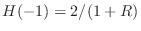 . In applications for
which the gain must be bounded by 1 at all frequencies, the dc blocker
may be scaled by the inverse of this maximum gain to yield
. In applications for
which the gain must be bounded by 1 at all frequencies, the dc blocker
may be scaled by the inverse of this maximum gain to yield
![\begin{eqnarray*}
H(z) &=& g\frac{1-z^{-1}}{1-Rz^{-1}}\\
y(n) &=& g[x(n) - x(n-1)] + R\, y(n-1), \quad\hbox{where}\\
g &\isdef & \frac{1+R}{2}.
\end{eqnarray*}](http://www.dsprelated.com/josimages_new/filters/img1464.png)
Next Section:
DC Blocker Software Implementations
Previous Section:
Allpass Filter Design












