Decay Time is Q Periods
Another well known rule of thumb is that the  of a resonator is the
number of ``periods'' under the exponential decay of its impulse
response. More precisely, we will show that, for
of a resonator is the
number of ``periods'' under the exponential decay of its impulse
response. More precisely, we will show that, for  , the
impulse response decays by the factor
, the
impulse response decays by the factor  in cycles, which
is about 96 percent decay, or -27 dB.
in cycles, which
is about 96 percent decay, or -27 dB.
The impulse response corresponding to Eq. (E.8) is found by
inverting the Laplace transform of the transfer function
(E.8) is found by
inverting the Laplace transform of the transfer function  . Since it
is only second order, the solution can be found in many tables of
Laplace transforms. Alternatively, we can break it up into a sum of
first-order terms which are invertible by inspection (possibly after
rederiving the Laplace transform of an exponential decay, which is
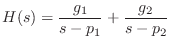
very simple). Thus we perform the partial fraction expansion of
Eq.(E.8) to obtain
. Since it
is only second order, the solution can be found in many tables of
Laplace transforms. Alternatively, we can break it up into a sum of
first-order terms which are invertible by inspection (possibly after
rederiving the Laplace transform of an exponential decay, which is
very simple). Thus we perform the partial fraction expansion of
Eq.(E.8) to obtain
 are given by Eq.(E.9), and some algebra gives
 |
 |
 |
(E.12) |
 |
|
 |
(E.13) |
as the respective residues of the poles
.
The impulse response is thus
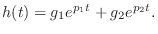
Assuming a resonator,  , we have
 , where
 (using notation of the
preceding section), and the impulse response reduces to
(using notation of the
preceding section), and the impulse response reduces to

 and
and  are overall amplitude and phase constants,
respectively.E.1
are overall amplitude and phase constants,
respectively.E.1
We have shown so far that the impulse response  decays as
 with a sinusoidal radian frequency
 under the exponential envelope. After Q periods at frequency
 , time has advanced to
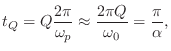 (E.7)
(E.7)
 .
Thus, after periods, the amplitude envelope has decayed to
.
Thus, after periods, the amplitude envelope has decayed to

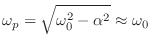
 , or .
Next Section:
Q as Energy Stored over Energy Dissipated
Previous Section:
Impulse Response