







Derivation
For notational simplicity, we restrict exposition to the
three-dimensional case. The general linear digital filter equation
 is written in three dimensions as
![\begin{displaymath}
\left[
\begin{array}{c}
y_0 \\ [2pt]
y_1 \\ [2pt]
y_2
\end{a...
...in{array}{c}
x_0 \\ [2pt]
x_1 \\ [2pt]
x_2
\end{array}\right].
\end{displaymath}](http://www.dsprelated.com/josimages_new/filters/img2304.png)
 is regarded as the input sample at time
  , and
, and  is
the output sample at time . The general causal time-invariant
filter appears in three-space as
is
the output sample at time . The general causal time-invariant
filter appears in three-space as
![\begin{displaymath}
H=\left[
\begin{array}{ccc}
h_0 & 0 & 0 \\ [2pt]
h_1 & h_0 & 0 \\ [2pt]
h_2 & h_1 & h_0
\end{array}\right].
\end{displaymath}](http://www.dsprelated.com/josimages_new/filters/img2306.png)
Consider the non-causal time-varying filter defined by
![\begin{displaymath}
C_3(k)={1/3}\left[
\begin{array}{ccc}
1 & W_3^1(k) & W_3^2(k...
...3^2(k) \\ [2pt]
1 & W_3^1(k) & {W_3^2(k)}
\end{array}\right].
\end{displaymath}](http://www.dsprelated.com/josimages_new/filters/img2307.png)
We may call  the collector matrix corresponding to the
  frequency.We have
![\begin{eqnarray*}
C_3(0)&=&\frac{1}{3}\left[
\begin{array}{ccc}
1 & 1 & 1 \\ [2p...
... e^{-j\frac{2\pi}{3}} & e^{j\frac{2\pi}{3}}
\end{array}\right].
\end{eqnarray*}](http://www.dsprelated.com/josimages_new/filters/img2309.png)
The top row of each matrix is recognized as a basis function for the
order three DFT (equispaced vectors on the unit circle). Accordingly,
we have the orthogonality and spanning properties of these vectors. So
let us define a basis for the signal space
 by
by
![\begin{displaymath}
x_0\isdef \left[
\begin{array}{c}
1 \\ [2pt]
1 \\ [2pt]
1
\e...
...rac{2\pi}{3}} \\ [2pt]
e^{j\frac{2\pi}{3}}
\end{array}\right].
\end{displaymath}](http://www.dsprelated.com/josimages_new/filters/img2311.png)
Then every component of
 and every component of
 when
when  . Now since any signal
  in
in  may
be written as a linear combination of
may
be written as a linear combination of
 , we find that
![\begin{displaymath}
C_3(k)X =
C_3(k)\sum_{i=0}^2\alpha_ix_i =
\sum_{i=0}^2\alp...
...[
\begin{array}{c}
1 \\ [2pt]
1 \\ [2pt]
1
\end{array}\right].
\end{displaymath}](http://www.dsprelated.com/josimages_new/filters/img2317.png)
 is a matrix which annihilates all
input basis components but the . Now multiply on the left
by a diagonal matrix
is a matrix which annihilates all
input basis components but the . Now multiply on the left
by a diagonal matrix  so that the product of times
  gives an arbitrary column vector
 . Then every linear
time-varying filter
. Then every linear
time-varying filter  is expressible as a sum of these products as
we will show below. In general, the decomposition for every filter on
is expressible as a sum of these products as
we will show below. In general, the decomposition for every filter on
 is simply
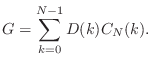
The uniqueness of the decomposition is easy to verify: Suppose there are two distinct decompositions of the form Eq.
 (H.1). Then for
some
(H.1). Then for
some  we have different D(k)'s. However, this implies that we can
get two distinct outputs in response to the input basis
function which is absurd.
we have different D(k)'s. However, this implies that we can
get two distinct outputs in response to the input basis
function which is absurd.
That every linear time-varying filter may be expressed in this form is
also easy to show. Given an arbitrary filter matrix of order N,
measure its response to each of the N basis functions (sine and cosine
replace
 ) to obtain a set of N by 1 column vectors.
The output vector due to the basis vector is precisely the
diagonal of .
) to obtain a set of N by 1 column vectors.
The output vector due to the basis vector is precisely the
diagonal of .
Next Section:
Summary
Previous Section:
Introduction












