An Easier Way
We derived the frequency response above using trig identities in order to minimize the mathematical level involved. However, it turns out it is actually easier, though more advanced, to use complex numbers for this purpose. To do this, we need Euler's identity:

where
 is the imaginary unit for complex numbers,
and
is the imaginary unit for complex numbers,
and  is a transcendental constant approximately equal to
 . Euler's identity is fully derived in
[84]; here we will simply use it ``on faith.'' It can be
proved by computing the Taylor series expansion of each side of
Eq.
. Euler's identity is fully derived in
[84]; here we will simply use it ``on faith.'' It can be
proved by computing the Taylor series expansion of each side of
Eq. (1.8) and showing equality term by term [84,14].
Complex Sinusoids
Using Euler's identity to represent sinusoids, we have

when time
 is continuous (see §A.1 for a list of notational
conventions), and when time is discrete,
is continuous (see §A.1 for a list of notational
conventions), and when time is discrete,

Any function of the form
 or
or
 will henceforth be called a complex
sinusoid.2.3 We will
see that it is easier to manipulate both sine and
cosine simultaneously in this form than it is to deal with
either
sine or cosine separately. One may even take the
point of view that
will henceforth be called a complex
sinusoid.2.3 We will
see that it is easier to manipulate both sine and
cosine simultaneously in this form than it is to deal with
either
sine or cosine separately. One may even take the
point of view that
 is simpler and more
fundamental than
is simpler and more
fundamental than
 or
or
 , as evidenced by
the following identities (which are immediate consequences of Euler's
identity,
Eq.(1.8)):
, as evidenced by
the following identities (which are immediate consequences of Euler's
identity,
Eq.(1.8)):


Thus, sine and cosine may each be regarded as a combination of two complex sinusoids. Another reason for the success of the complex sinusoid is that we will be concerned only with real linear operations on signals. This means that
 in Eq.(1.8)
will never be multiplied by or raised to a power by a linear
filter with real coefficients. Therefore, the real and imaginary parts
of that equation are actually treated independently. Thus, we
can feed a complex sinusoid into a filter, and the real part of the
output will be the cosine response and the imaginary part of
the output will be the sine response. For the student new to
analysis using complex variables, natural questions at this point
include ``Why ?, Where did the imaginary exponent come from? Are
imaginary exponents legal?'' and so on. These questions are fully
answered in [84] and elsewhere [53,14].
Here, we will look only at some intuitive connections between complex
sinusoids and the more familiar real sinusoids.
in Eq.(1.8)
will never be multiplied by or raised to a power by a linear
filter with real coefficients. Therefore, the real and imaginary parts
of that equation are actually treated independently. Thus, we
can feed a complex sinusoid into a filter, and the real part of the
output will be the cosine response and the imaginary part of
the output will be the sine response. For the student new to
analysis using complex variables, natural questions at this point
include ``Why ?, Where did the imaginary exponent come from? Are
imaginary exponents legal?'' and so on. These questions are fully
answered in [84] and elsewhere [53,14].
Here, we will look only at some intuitive connections between complex
sinusoids and the more familiar real sinusoids.
Complex Amplitude
Note that the amplitude  and phase
  can be viewed as the
magnitude and angle of a single complex number
can be viewed as the
magnitude and angle of a single complex number
 (1.9) or Eq.(1.10). The complex amplitude is the same
whether we are talking about the continuous-time sinusoid
or the discrete-time sinusoid
.
(1.9) or Eq.(1.10). The complex amplitude is the same
whether we are talking about the continuous-time sinusoid
or the discrete-time sinusoid
.
Phasor Notation
The complex amplitude
 is also defined as the
phasor associated with any sinusoid having amplitude and
phase . The term ``phasor'' is more general than ``complex
amplitude'', however, because it also applies to the corresponding
real sinusoid given by the real part of Equations (1.9-1.10).
In other words, the real sinusoids
is also defined as the
phasor associated with any sinusoid having amplitude and
phase . The term ``phasor'' is more general than ``complex
amplitude'', however, because it also applies to the corresponding
real sinusoid given by the real part of Equations (1.9-1.10).
In other words, the real sinusoids
 and
and
 may be expressed as
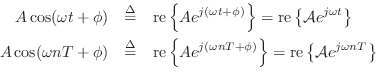
and  is the associated phasor in each case. Thus, we say that
the phasor representation of
is
. Phasor analysis is
often used to analyze linear time-invariant systems such as analog
electrical circuits.
is the associated phasor in each case. Thus, we say that
the phasor representation of
is
. Phasor analysis is
often used to analyze linear time-invariant systems such as analog
electrical circuits.
Plotting Complex Sinusoids as Circular Motion
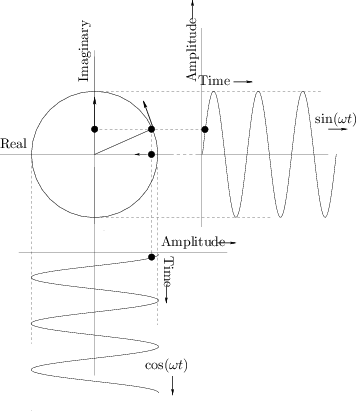
Figure 1.8 shows Euler's relation graphically as it applies to
sinusoids. A point traveling with uniform velocity around a circle
with radius 1 may be represented by
 in
the complex plane, where is time and
in
the complex plane, where is time and  is the number of
revolutions per second. The projection of this motion onto the
horizontal (real) axis is
is the number of
revolutions per second. The projection of this motion onto the
horizontal (real) axis is
 , and the projection onto
the vertical (imaginary) axis is
, and the projection onto
the vertical (imaginary) axis is
 . For
discrete-time circular motion, replace by
. For
discrete-time circular motion, replace by  to get
 which may be interpreted as a
point which jumps an arc length
which may be interpreted as a
point which jumps an arc length
 radians along the circle
each sampling instant.
radians along the circle
each sampling instant.
 |
 (Eq.
(Eq. onto
the real axis is
onto
the real axis is
 .
.

For circular motion to ensue, the sinusoidal motions must be at the same frequency, one-quarter cycle out of phase, and perpendicular (orthogonal) to each other. (With phase differences other than one-quarter cycle, the motion is generally elliptical.)
The converse of this is also illuminating. Take the usual circular
motion
 which spins counterclockwise along the unit
circle as increases, and add to it a similar but clockwise
circular motion
which spins counterclockwise along the unit
circle as increases, and add to it a similar but clockwise
circular motion
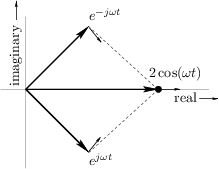
 . This is shown in
Fig.1.9. Next apply Euler's identity to get
. This is shown in
Fig.1.9. Next apply Euler's identity to get

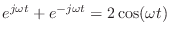
Thus,
This statement is a graphical or geometric interpretation of Eq.
(1.11). A similar derivation (subtracting instead of adding) gives the
sine identity Eq.(1.12).
We call
a
positive-frequency sinusoidal component
when
 , and
is the
corresponding negative-frequency component. Note that both
sine and cosine signals have equal-amplitude positive- and
negative-frequency components (see also [84,53]). This
happens to be true of every real signal (i.e., non-complex). To
see this, recall that every signal can be represented as a sum of
complex sinusoids at various frequencies (its Fourier
expansion). For the signal to be real, every positive-frequency
complex sinusoid must be summed with a negative-frequency sinusoid of
equal amplitude. In other words, any counterclockwise circular motion
must be matched by an equal and opposite clockwise circular motion in
order that the imaginary parts always cancel to yield a real signal
(see Fig.1.9). Thus, a real signal always has a magnitude
spectrum which is symmetric about 0 Hz. Fourier symmetries such as
this are developed more completely in [84].
, and
is the
corresponding negative-frequency component. Note that both
sine and cosine signals have equal-amplitude positive- and
negative-frequency components (see also [84,53]). This
happens to be true of every real signal (i.e., non-complex). To
see this, recall that every signal can be represented as a sum of
complex sinusoids at various frequencies (its Fourier
expansion). For the signal to be real, every positive-frequency
complex sinusoid must be summed with a negative-frequency sinusoid of
equal amplitude. In other words, any counterclockwise circular motion
must be matched by an equal and opposite clockwise circular motion in
order that the imaginary parts always cancel to yield a real signal
(see Fig.1.9). Thus, a real signal always has a magnitude
spectrum which is symmetric about 0 Hz. Fourier symmetries such as
this are developed more completely in [84].
Rederiving the Frequency Response
Let's repeat the mathematical sine-wave analysis of the simplest
low-pass filter, but this time using a complex sinusoid instead of a
real one. Thus, we will test the filter's response at frequency
by setting its input to
 , so let
  . Similarly, owing to linearity, we
may normalize to 1. By virtue of Euler's relation Eq.(1.8) and
the linearity of the filter, setting the input to
. Similarly, owing to linearity, we
may normalize to 1. By virtue of Euler's relation Eq.(1.8) and
the linearity of the filter, setting the input to
 is physically equivalent to putting
 into one
copy of the filter and
into one
copy of the filter and
 into a separate copy of the
same filter. The signal path where the cosine goes in is the
real part of the signal, and the other signal path is simply called
the imaginary part. Thus, a complex signal in real life is
implemented as two real signals processed in parallel; in particular,
a complex sinusoid is implemented as two real sinusoids, side by side,
one-quarter cycle out of phase. When the filter itself is real, two
copies of it suffice to process a complex signal. If the filter is
complex, we must implement complex multiplies between the complex
signal samples and filter coefficients.
into a separate copy of the
same filter. The signal path where the cosine goes in is the
real part of the signal, and the other signal path is simply called
the imaginary part. Thus, a complex signal in real life is
implemented as two real signals processed in parallel; in particular,
a complex sinusoid is implemented as two real sinusoids, side by side,
one-quarter cycle out of phase. When the filter itself is real, two
copies of it suffice to process a complex signal. If the filter is
complex, we must implement complex multiplies between the complex
signal samples and filter coefficients.
Using the normal rules for manipulating exponents, we find that the
output of the simple low-pass filter in response to the complex
sinusoid at frequency
 Hz is given by
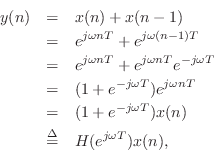
where we have defined
 , which we
will show is in fact the frequency response of this filter at
frequency
, which we
will show is in fact the frequency response of this filter at
frequency  . This derivation is clearly easier than the
trigonometry approach. What may be puzzling at first, however, is
that the filter is expressed as a frequency-dependent complex
multiply (when the input signal is a complex sinusoid). What does
this mean? Well, the theory we are blindly trusting at this point
says it must somehow mean a gain scaling and a phase shift. This is
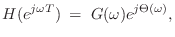
true and easy to see once the complex filter gain is expressed in
polar form,
. This derivation is clearly easier than the
trigonometry approach. What may be puzzling at first, however, is
that the filter is expressed as a frequency-dependent complex
multiply (when the input signal is a complex sinusoid). What does
this mean? Well, the theory we are blindly trusting at this point
says it must somehow mean a gain scaling and a phase shift. This is
true and easy to see once the complex filter gain is expressed in
polar form,
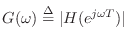 (the absolute value, or modulus of
  ), and the
phase shift in radians versus frequency is given by the phase angle
(or argument)
), and the
phase shift in radians versus frequency is given by the phase angle
(or argument)
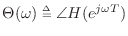 . In
other words, we must find
. In
other words, we must find
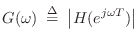
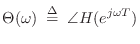 (1.1).
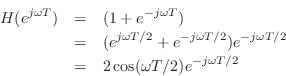
It is now easy to see that
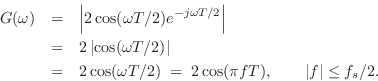
and
 (1.1). The gain of the simplest
low-pass filter varies, as cosine varies, from 2 to 0 as the
frequency of an input sinusoid goes from 0 to half the sampling
rate. In other words, the amplitude response of Eq.(1.1) goes
sinusoidally from 2 to 0 as
(1.1). The gain of the simplest
low-pass filter varies, as cosine varies, from 2 to 0 as the
frequency of an input sinusoid goes from 0 to half the sampling
rate. In other words, the amplitude response of Eq.(1.1) goes
sinusoidally from 2 to 0 as  goes from 0 to
  . It does
seem somewhat reasonable to consider it a low-pass, and it is a poor
one in the sense that it is hard to see which frequency should be
called the cut-off frequency. We see that the spectral ``roll-off'' is
very slow, as low-pass filters go, and this is what we pay for the
extreme simplicity of Eq.(1.1). The phase response
. It does
seem somewhat reasonable to consider it a low-pass, and it is a poor
one in the sense that it is hard to see which frequency should be
called the cut-off frequency. We see that the spectral ``roll-off'' is
very slow, as low-pass filters go, and this is what we pay for the
extreme simplicity of Eq.(1.1). The phase response
 is linear in frequency, which gives rise to a constant
time delay irrespective of the signal frequency.
is linear in frequency, which gives rise to a constant
time delay irrespective of the signal frequency.
It deserves to be emphasized that all a linear time-invariant filter
can do to a sinusoid is scale its amplitude and change
its phase. Since a sinusoid is completely determined by its amplitude
, frequency , and phase , the constraint on the filter is
that the output must also be a sinusoid, and furthermore it must be at
the same frequency as the input sinusoid. More explicitly:
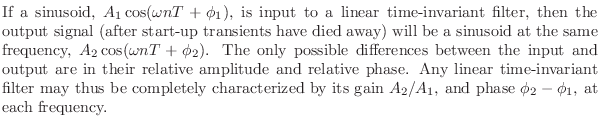
Mathematically, a sinusoid has no beginning and no end, so there really are no start-up transients in the theoretical setting. However, in practice, we must approximate eternal sinusoids with finite-time sinusoids whose starting time was so long ago that the filter output is essentially the same as if the input had been applied forever.
Tying it all together, the general output of a linear time-invariant filter with a complex sinusoidal input may be expressed as
![\begin{eqnarray*}
y(n) &=& (\textit{Complex Filter Gain}) \;\textit{times}\;\, (...
...ith Radius $[G(\omega)A]$\ and Phase $[\phi + \Theta(\omega)]$}.
\end{eqnarray*}](http://www.dsprelated.com/josimages_new/filters/img241.png)
Next Section:
Summary
Previous Section:
Finding the Frequency Response