Effect of Measurement Noise
In practice, measurements are never perfect. Let
 denote the measured output signal, where
 is a vector of
``measurement noise'' samples. Then we have
is a vector of
``measurement noise'' samples. Then we have
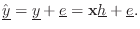
 is obtained by orthogonally projecting
 onto the space spanned by the columns of
 . Geometrically
speaking, choosing
to minimize the Euclidean distance between
and
. Geometrically
speaking, choosing
to minimize the Euclidean distance between
and
 is the same thing as choosing it to minimize the
sum of squared estimated measurement errors
is the same thing as choosing it to minimize the
sum of squared estimated measurement errors
 .
The distance from
to
is minimized when the
projection error
.
The distance from
to
is minimized when the
projection error
 is orthogonal to every
column of
, which is true if and only if
is orthogonal to every
column of
, which is true if and only if
 [84].
Thus, we have, applying the orthogonality principle,
[84].
Thus, we have, applying the orthogonality principle,
 yields Eq.
 (F.8) as before, but this time we have
derived it as the least squares estimate of
in the presence of
output measurement error.
(F.8) as before, but this time we have
derived it as the least squares estimate of
in the presence of
output measurement error.
It is also straightforward to introduce a weighting function in
the least-squares estimate for
by replacing
 in the
derivations above by
in the
derivations above by
 , where
  is any positive definite
matrix (often taken to be diagonal and positive). In the present
time-domain formulation, it is difficult to choose a
weighting function that corresponds well to audio perception.
Therefore, in audio applications, frequency-domain formulations are
generally more powerful for linear-time-invariant system
identification. A practical example is the frequency-domain
equation-error method described in §I.4.4 [78].
is any positive definite
matrix (often taken to be diagonal and positive). In the present
time-domain formulation, it is difficult to choose a
weighting function that corresponds well to audio perception.
Therefore, in audio applications, frequency-domain formulations are
generally more powerful for linear-time-invariant system
identification. A practical example is the frequency-domain
equation-error method described in §I.4.4 [78].
Next Section:
Matlab System Identification Example
Previous Section:
State Space Filter Realization Example