Sign in

username:

password:


Not a member?

Search Online Books


Search tips

Free Online Books

Chapters

Chapter Contents:

Search Introduction to Digital Filters


Book Index | Global Index


Would you like to be notified by email when Julius Orion Smith III publishes a new entry into his blog?


Example: The General Biquad PFE

The general second-order case with $ M=N=2$ (the so-called biquad section) can be written when $ b_0\ne 0$ as

$\displaystyle H(z) \eqsp g\frac{1 + b_1 z^{-1}+ b_2 z^{-2}}{1 + a_1 z^{-1}+ a_2 z^{-2}}.
$

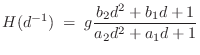
To perform a partial fraction expansion, we need to extract an order 0 (length 1) FIR part via long division. Let $ d=z^{-1}$ and rewrite $ H(z)$ as a ratio of polynomials in $ d$:

$\displaystyle H(d^{-1}) \eqsp g\frac{b_2 d^2 + b_1 d + 1 }{a_2 d^2 + a_1 d + 1}
$

Then long division gives % For typesetting long division --- NEEDED WITHIN THE MAKEIMAGE ENV?
% (raw TeX,...
...}
& & b_1-\frac{b_2}{a_2}a_1 & 1-\frac{b_2}{a_2} &
\end{array}\end{displaymath}
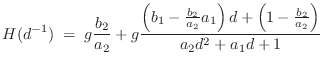
yielding

$\displaystyle H(d^{-1}) \eqsp g\frac{b_2}{a_2} + g\frac{\left(b_1-\frac{b_2}{a_2}a_1\right)d+
\left(1-\frac{b_2}{a_2}\right)}{a_2d^2 + a_1d + 1}
$

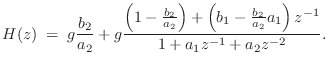
or

$\displaystyle H(z) \eqsp g\frac{b_2}{a_2} +
g\frac{\left(1-\frac{b_2}{a_2}\right)
+\left(b_1-\frac{b_2}{a_2}a_1\right)z^{-1}}{1 + a_1z^{-1}+ a_2z^{-2}}.
$

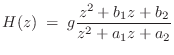
The delayed form of the partial fraction expansion is obtained by leaving the coefficients in their original order. This corresponds to writing $ H(z)$ as a ratio of polynomials in $ z$:

$\displaystyle H(z) \eqsp g\frac{z^2 + b_1 z + b_2 }{z^2 + a_1 z + a_2}
$

Long division now looks like % For typesetting long division --- NEEDED WITHIN THE MAKEIMAGE ENV?\begin{dis...
...rule width 22\digitwidth}}
& & b_1-a_1 & b_2-a_2 &
\end{array}\end{displaymath}
giving

$\displaystyle H(z) \eqsp g + z^{-1}g\frac{(b_1-a_1) + (b_2-a_2)z^{-1}}{1 + a_1 z^{-1}+ a_2 z^{-2}}.
$

Numerical examples of partial fraction expansions are given in §6.8.8 below. Another worked example, in which the filter $ y(n) = x(n) + 0.5^3 x(n-3) - 0.9^5 y(n-5)$ is converted to a set of parallel, second-order sections is given in §3.12. See also §9.2 regarding conversion to second-order sections in general, and §G.9.1 (especially Eq.$ \,$(G.22)) regarding a state-space approach to partial fraction expansion.


Order a Hardcopy of Introduction to Digital Filters

Previous: FIR Part of a PFE
Next: Alternate PFE Methods

written by Julius Orion Smith III
Julius Smith's background is in electrical engineering (BS Rice 1975, PhD Stanford 1983). He is presently Professor of Music and Associate Professor (by courtesy) of Electrical Engineering at Stanford's Center for Computer Research in Music and Acoustics (CCRMA), teaching courses and pursuing research related to signal processing applied to music and audio systems. See http://ccrma.stanford.edu/~jos/ for details.


Comments


No comments yet for this page


Add a Comment
You need to login before you can post a comment (best way to prevent spam). ( Not a member? )