Example
It is easy to classify completely all first-order FIR filters:
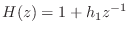
 to 1 for simplicity. We have a single
zero at
to 1 for simplicity. We have a single
zero at  . If
. If
 , the filter is minimum phase. If
 , it is maximum phase. Note that the minimum-phase case
is the one in which the impulse response
, it is maximum phase. Note that the minimum-phase case
is the one in which the impulse response
![$ [1,h_1,0,\ldots]$](http://www.dsprelated.com/josimages_new/filters/img1262.png) decays instead of grows. It can be shown that this is a general
property of minimum-phase sequences, as elaborated in the next
section.
decays instead of grows. It can be shown that this is a general
property of minimum-phase sequences, as elaborated in the next
section.
Next Section:
Units
Previous Section:
Software for Linear-Phase Filter Design