Examples of Digital Filters
While any mapping from signals to real numbers can be called a filter, we normally work with filters which have more structure than that. Some of the main structural features are illustrated in the following examples.
The filter analyzed in Chapter 1 was specified by

The above example remains a real LTI filter if we scale the input samples by any real coefficients:

If we use complex coefficients, the filter remains LTI, but it becomes a complex filter:

The filter also remains LTI if we use more input samples in a shift-invariant way:

 in this
difference equation, makes this a non-causal
filter example. Causal filters may compute
in this
difference equation, makes this a non-causal
filter example. Causal filters may compute  using only
present and/or past input samples
using only
present and/or past input samples  ,
,  ,
,
 , and so on.
Another class of causal LTI filters involves using past output samples in addition to present and/or past input samples. The past-output terms are called feedback, and digital filters employing feedback are called recursive digital filters:

An example multi-input, multi-output (MIMO) digital filter is
![$\displaystyle \left[\begin{array}{c} y_1(n) \\ [2pt] y_2(n) \end{array}\right] ...
...y}\right]\left[\begin{array}{c} x_1(n-1) \\ [2pt] x_2(n-1) \end{array}\right],
$](http://www.dsprelated.com/josimages_new/filters/img426.png)
 .
.
The simplest nonlinear digital filter is

 is not dependent on past
inputs or outputs. The nonlinear filter
is not dependent on past
inputs or outputs. The nonlinear filter
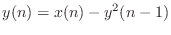
Another nonlinear filter example is the
median smoother of order  which assigns the middle value of
input samples centered about time to the output at time .
It is useful for ``outlier'' elimination. For example, it will reject
isolated noise spikes, and preserve steps.
which assigns the middle value of
input samples centered about time to the output at time .
It is useful for ``outlier'' elimination. For example, it will reject
isolated noise spikes, and preserve steps.
An example of a linear time-varying filter is
 changes over
time. It is linear because no coefficients depend on
changes over
time. It is linear because no coefficients depend on  or
or  .
.
These examples provide a kind of ``bottom up'' look at some of the major types of digital filters. We will now take a ``top down'' approach and characterize all linear, time-invariant filters mathematically. This characterization will enable us to specify frequency-domain analysis tools that work for any LTI digital filter.
Next Section:
Linear Filters
Previous Section:
Definition of a Filter