Existence of the Z Transform
The z transform of a finite-amplitude
signal  will always exist provided (1) the signal starts at a finite time and (2) it is
asymptotically exponentially bounded, i.e., there exists a
finite integer
will always exist provided (1) the signal starts at a finite time and (2) it is
asymptotically exponentially bounded, i.e., there exists a
finite integer  , and finite real numbers
  and
and  ,
such that
,
such that
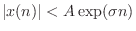 for all
  . The
bounding exponential may even be growing with
. The
bounding exponential may even be growing with  (
( ). These are
not the most general conditions for existence of the z transform, but they
suffice for most practical purposes.
). These are
not the most general conditions for existence of the z transform, but they
suffice for most practical purposes.
For a signal  growing as
 , for , one
would naturally expect the z transform
, for , one
would naturally expect the z transform  to be defined only in the
region
to be defined only in the
region
 of the complex plane. This is expected
because the infinite series
of the complex plane. This is expected
because the infinite series
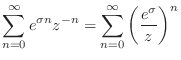 to ensure convergence. Since
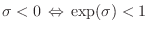 for a decaying
exponential, we see that the region of convergence of the
for a decaying
exponential, we see that the region of convergence of the  transform of a decaying exponential always includes the unit circle of
the plane.
transform of a decaying exponential always includes the unit circle of
the plane.
More generally, it turns out that, in all cases of practical interest,
the domain of can be extended to include the
entire complex plane, except at isolated ``singular''
points7.2 at which  approaches
infinity (such as at
approaches
infinity (such as at
 when
when
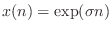 ).
The mathematical technique for doing this is called analytic
continuation, and it is described in §D.1 as applied to the
Laplace transform (the continuous-time counterpart of the z transform).
A point to note, however, is that in the extension region (all points
such that
).
The mathematical technique for doing this is called analytic
continuation, and it is described in §D.1 as applied to the
Laplace transform (the continuous-time counterpart of the z transform).
A point to note, however, is that in the extension region (all points
such that
 in the above example), the signal
component corresponding to each singularity inside the extension
region is ``flipped'' in the time domain. That is, ``causal''
exponentials become ``anticausal'' exponentials, as discussed in
§8.7.
in the above example), the signal
component corresponding to each singularity inside the extension
region is ``flipped'' in the time domain. That is, ``causal''
exponentials become ``anticausal'' exponentials, as discussed in
§8.7.
The z transform is discussed more fully elsewhere [52,60], and we will derive below only what we will need.
Next Section:
Shift and Convolution Theorems
Previous Section:
The Z Transform