







An FFT-Based Equation-Error Method
The algorithm below minimizes the equation error in the frequency-domain. As a result, it can make use of the FFT for speed. This algorithm is implemented in Matlab's invfreqz() function when no iteration-count is specified. (The iteration count gives that many iterations of the Steiglitz-McBride algorithm, thus transforming equation error to output error after a few iterations. There is also a time-domain implementation of the Steiglitz-McBride algorithm called stmcb() in the Matlab Signal Processing Toolbox, which takes the desired impulse response as input.)
Given a desired spectrum
 at equally spaced frequencies
 , with
  a power of
  ,
it is desired to find a rational digital
filter with
,
it is desired to find a rational digital
filter with  zeros and
  poles,
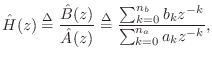
 , such that
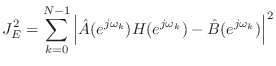
Since  is a quadratic form, the solution is readily obtained by
equating the gradient to zero. An easier derivation follows from minimizing
equation error variance in the time domain and making use of the orthogonality
principle [36].
This may be viewed as a system identification problem where the
known input signal is an impulse, and the known output is the desired
impulse response. A formulation employing an arbitrary known input
is valuable for introducing complex weighting across the frequency grid,
and this general form is presented. A detailed derivation appears in
[78, Chapter 2], and here only the final algorithm is given:
is a quadratic form, the solution is readily obtained by
equating the gradient to zero. An easier derivation follows from minimizing
equation error variance in the time domain and making use of the orthogonality
principle [36].
This may be viewed as a system identification problem where the
known input signal is an impulse, and the known output is the desired
impulse response. A formulation employing an arbitrary known input
is valuable for introducing complex weighting across the frequency grid,
and this general form is presented. A detailed derivation appears in
[78, Chapter 2], and here only the final algorithm is given:
Given spectral output samples
 and input
samples
and input
samples
 , we minimize

 is to be used as a weighting function in the
filter-design problem, then we set
is to be used as a weighting function in the
filter-design problem, then we set
 .
.
Let
 :
:![$ \,n_2]$](http://www.dsprelated.com/josimages_new/filters/img2433.png) denote the column vector determined
by
denote the column vector determined
by  , for
, for
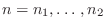 filled in from top to bottom, and let
 :
:![$ \,n_2])$](http://www.dsprelated.com/josimages_new/filters/img2436.png) denote the size
denote the size  symmetric Toeplitz matrix consisting of
: in its first column.
A nonsymmetric Toeplitz matrix may be specified by its first column and row,
and we use the notation
symmetric Toeplitz matrix consisting of
: in its first column.
A nonsymmetric Toeplitz matrix may be specified by its first column and row,
and we use the notation
 :
:![$ \,n_2],\underline{y}^T[m_1\,$](http://www.dsprelated.com/josimages_new/filters/img2439.png) :
:![$ \,m_2])$](http://www.dsprelated.com/josimages_new/filters/img2440.png) to denote the
by
to denote the
by  Toeplitz matrix with left-most column
: and top row
Toeplitz matrix with left-most column
: and top row
 :
:![$ \,m_2]$](http://www.dsprelated.com/josimages_new/filters/img2443.png) .
The inverse Fourier transform of
.
The inverse Fourier transform of
 is defined as
 FFT
FFT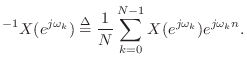
 is optional since it has no effect on the solution.
We require three correlation functions involving
is optional since it has no effect on the solution.
We require three correlation functions involving  and
and  ,
,
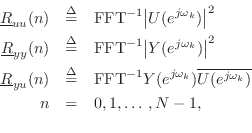
where the overbar denotes complex conjugation, and four corresponding Toeplitz matrices,
![\begin{eqnarray*}
R_{yy} &\isdef & T(\underline{R}_{yy}[0\,\mbox{:}\,{{n}_a}-1])...
...u}^T[-1\,\mbox{:}\,-{{n}_a}])\\
R_{uy} &\isdef & R_{uy}^T , \\
\end{eqnarray*}](http://www.dsprelated.com/josimages_new/filters/img2450.png)
where negative indices are to be interpreted mod , e.g.,
 .
.
The solution is then
![$\displaystyle \hat{\theta}^\ast = \left[\begin{array}{c} \underline{\hat{B}}^\a...
...,{{n}_b}] \\ [2pt] \underline{R}_{yy}[1\,\mbox{:}\,{{n}_a}] \end{array}\right]
$](http://www.dsprelated.com/josimages_new/filters/img2452.png)
![$\displaystyle \underline{\hat{B}}^\ast \isdef \left[\begin{array}{c} \hat{b}^\a...
...t{a}^\ast _0 \\ [2pt] \vdots \\ [2pt] \hat{a}^\ast _{{n}_a}\end{array}\right],
$](http://www.dsprelated.com/josimages_new/filters/img2453.png)
Next Section:
Prony's Method
Previous Section:
Stability of Equation Error Designs












