FIR Part of a PFE
When  in Eq.
 (6.7), we may perform a step of long division
of
(6.7), we may perform a step of long division
of  to produce an FIR part in parallel with a
strictly proper IIR part:
to produce an FIR part in parallel with a
strictly proper IIR part:
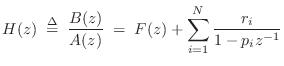
where

When  , we define
  . This type of decomposition is
computed by the residuez function (a matlab function for
computing a complete partial fraction expansion, as illustrated in
§6.8.8 below).
. This type of decomposition is
computed by the residuez function (a matlab function for
computing a complete partial fraction expansion, as illustrated in
§6.8.8 below).
An alternate FIR part is obtained by performing long division on the reversed polynomial coefficients to obtain
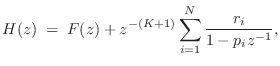
where
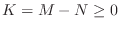 is again the order of the FIR part.
This type of decomposition is computed (as part of the PFE)
by residued, described in §J.6 and illustrated
numerically in §6.8.8 below.
is again the order of the FIR part.
This type of decomposition is computed (as part of the PFE)
by residued, described in §J.6 and illustrated
numerically in §6.8.8 below.
We may compare these two PFE alternatives as follows:
Let  denote
  ,
,
 , and
, and
 .
(I.e., we use a subscript to indicate polynomial order, and `
.
(I.e., we use a subscript to indicate polynomial order, and ` ' is
omitted for notational simplicity.) Then for
we have two cases:
' is
omitted for notational simplicity.) Then for
we have two cases:

In the first form, the
 coefficients are ``left
justified'' in the reconstructed numerator, while in the second form
they are ``right justified''. The second form is generally more
efficient for modeling purposes, since the numerator of the IIR
part (
coefficients are ``left
justified'' in the reconstructed numerator, while in the second form
they are ``right justified''. The second form is generally more
efficient for modeling purposes, since the numerator of the IIR
part (
 ) can be used to match additional
terms in the impulse response after the FIR part
) can be used to match additional
terms in the impulse response after the FIR part  has
``died out''.
has
``died out''.
In summary, an arbitrary digital filter transfer function  with
with
 distinct poles can always be expressed as a parallel combination
of complex one-pole filters, together with a parallel FIR part
when . When there is an FIR part, the strictly proper IIR
part may be delayed such that its impulse response begins where that
of the FIR part leaves off.
distinct poles can always be expressed as a parallel combination
of complex one-pole filters, together with a parallel FIR part
when . When there is an FIR part, the strictly proper IIR
part may be delayed such that its impulse response begins where that
of the FIR part leaves off.
In artificial reverberation applications, the FIR part may correspond to the early reflections, while the IIR part provides the late reverb, which is typically dense, smooth, and exponentially decaying [86]. The predelay (``pre-delay'') control in some commercial reverberators is the amount of pure delay at the beginning of the reverberator's impulse response. Thus, neglecting the early reflections, the order of the FIR part can be viewed as the amount of predelay for the IIR part.
Example: The General Biquad PFE
The general second-order case with  (the so-called
biquad section) can be written when
(the so-called
biquad section) can be written when  as
as

 and rewrite
as a ratio of polynomials in
and rewrite
as a ratio of polynomials in  :
:
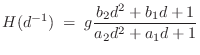

yielding
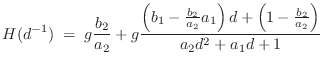
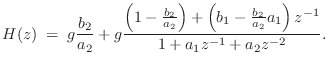
The delayed form of the partial fraction expansion is obtained by
leaving the coefficients in their original order. This corresponds
to writing as a ratio of polynomials in  :
:
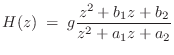

giving

Numerical examples of partial fraction expansions are given in §6.8.8
below. Another worked example, in which the filter
 is converted to a set of parallel, second-order
sections is given in §3.12. See also §9.2 regarding
conversion to second-order sections in general, and §G.9.1 (especially
Eq.(G.22)) regarding
a state-space approach to partial fraction expansion.
is converted to a set of parallel, second-order
sections is given in §3.12. See also §9.2 regarding
conversion to second-order sections in general, and §G.9.1 (especially
Eq.(G.22)) regarding
a state-space approach to partial fraction expansion.
Next Section:
Alternate PFE Methods
Previous Section:
Inverting the Z Transform