







Frequency Response
Given the transfer function  , the frequency response is
obtained by evaluating it on the unit circle in the complex plane,
i.e., by setting
, the frequency response is
obtained by evaluating it on the unit circle in the complex plane,
i.e., by setting
 , where
  is the sampling interval in
seconds, and
is the sampling interval in
seconds, and  is radian frequency:4.3

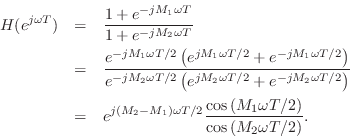
In the special case
 , we obtain
When
 , the frequency response is a ratio of cosines in
times a linear phase term
, the frequency response is a ratio of cosines in
times a linear phase term
 (which
corresponds to a pure delay of
(which
corresponds to a pure delay of  samples). This special case
gives insight into the behavior of the filter as its coefficients
samples). This special case
gives insight into the behavior of the filter as its coefficients
 and
and  approach 1.
When
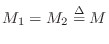 , the filter degenerates to
  which
corresponds to
which
corresponds to  ; in this case, the delayed input and output
signals cancel each other out. As a check, let's verify this in the
time domain:
; in this case, the delayed input and output
signals cancel each other out. As a check, let's verify this in the
time domain:
![\begin{eqnarray*}
y(n) &=& x(n) + x(n-M) - y(n-M)\\
&=& x(n) + x(n-M) - [x(n-M...
...) - y(n-3M)]\\
&=& x(n) + y(n-3M)\\
&=& \cdots\\
&=& x(n).
\end{eqnarray*}](http://www.dsprelated.com/josimages_new/filters/img331.png)
Next Section:
Amplitude Response
Previous Section:
Transfer Function












