General Causal Linear Filter Matrix
To be causal, the filter output at time
![$ n\in[0,N-1]$](http://www.dsprelated.com/josimages_new/filters/img1958.png) cannot
depend on the input at any times
cannot
depend on the input at any times  greater than
  . This implies
that a causal filter matrix must be lower triangular. That is,
it must have zeros above the main diagonal. Thus, a causal linear filter
matrix
. This implies
that a causal filter matrix must be lower triangular. That is,
it must have zeros above the main diagonal. Thus, a causal linear filter
matrix
 will have entries that satisfy
  for
for  .
.
For example, the general  causal, linear, digital-filter
matrix operating on three-sample sequences is
causal, linear, digital-filter
matrix operating on three-sample sequences is
![$\displaystyle \mathbf{h}= \left[\begin{array}{ccc}
h_{00} & 0 & 0\\ [2pt]
h_{10} & h_{11} & 0\\ [2pt]
h_{20} & h_{21} & h_{22}
\end{array}\right]
$](http://www.dsprelated.com/josimages_new/filters/img1962.png)
![$\displaystyle \left[\begin{array}{c} y_0 \\ [2pt] y_1 \\ [2pt] y_2\end{array}\r...
...left[\begin{array}{c} x_0 \\ [2pt] x_1 \\ [2pt] x_2\end{array}\right], \protect$](http://www.dsprelated.com/josimages_new/filters/img1963.png)
or, more explicitly,


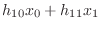


While Eq. (F.2) covers the general case of linear, causal, digital
filters operating on the space of three-sample sequences, it includes
time varying filters, in general. For example, the gain of the
``current input sample'' changes over time as
(F.2) covers the general case of linear, causal, digital
filters operating on the space of three-sample sequences, it includes
time varying filters, in general. For example, the gain of the
``current input sample'' changes over time as
 .
.
Next Section:
General LTI Filter Matrix
Previous Section:
Introduction