







Geometric Series
The essence of the situation can be illustrated using a simple
geometric series. Let  be any real (or complex) number. Then we
have
be any real (or complex) number. Then we
have
 when
when
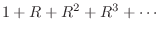 is
guaranteed to be summable when
is
guaranteed to be summable when  , and in that case, the sum is
given by
, and in that case, the sum is
given by  . On the other hand, if
  , we can rewrite
as
, we can rewrite
as
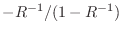 to obtain
![$\displaystyle \frac{1}{1-R} \eqsp \frac{-R^{-1}}{1-R^{-1}}
\eqsp -R^{-1}\left[1 + R^{-1} + R^{-2} + R^{-3} + \cdots \right]
$](http://www.dsprelated.com/josimages_new/filters/img1083.png) . Thus, is a valid
closed-form sum whether or not
. Thus, is a valid
closed-form sum whether or not  is less than or greater than 1.
When , it is the sum of the causal geometric series in powers
of . When , it is the sum of the causal geometric series in
powers of
is less than or greater than 1.
When , it is the sum of the causal geometric series in powers
of . When , it is the sum of the causal geometric series in
powers of  , or, an anticausal geometric series in
(negative) powers of .
, or, an anticausal geometric series in
(negative) powers of .
Next Section:
One-Pole Transfer Functions
Previous Section:
Testing Filter Stability in Matlab












