Graphical Computation of
Amplitude Response from
Poles and Zeros
Now consider what happens when we take the factored form of the
general transfer function, Eq. (8.2), and set
  to
to
 to get the frequency response in factored form:

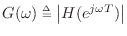 .
.





In the complex plane, the number
 is plotted at the
coordinates
is plotted at the
coordinates  [84]. The difference of two vectors
 and
and
 is
is
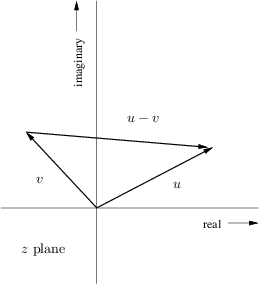
 , as shown in Fig.8.1. Translating the origin of the
vector
, as shown in Fig.8.1. Translating the origin of the
vector  to the tip of
  shows that is an arrow drawn
from the tip of to the tip of
shows that is an arrow drawn
from the tip of to the tip of  . The length of a vector is
unaffected by translation away from the origin. However, the angle of
a translated vector must be measured relative to a translated copy of
the real axis. Thus the term
. The length of a vector is
unaffected by translation away from the origin. However, the angle of
a translated vector must be measured relative to a translated copy of
the real axis. Thus the term
 may be drawn as an
arrow from the
may be drawn as an
arrow from the  th zero to the point
on the unit
circle, and
th zero to the point
on the unit
circle, and
 is an arrow from the th
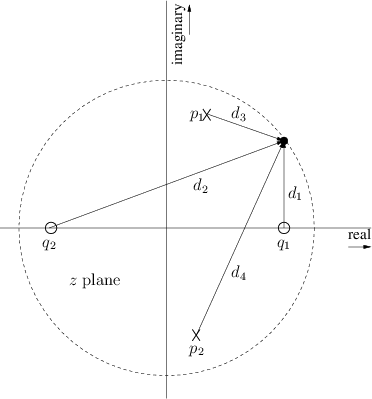
pole. Therefore, each term in Eq.(8.3) is the length
of a vector drawn from a pole or zero to a single point on the unit
circle, as shown in Fig.8.2 for two poles and two zeros.
In summary:
is an arrow from the th
pole. Therefore, each term in Eq.(8.3) is the length
of a vector drawn from a pole or zero to a single point on the unit
circle, as shown in Fig.8.2 for two poles and two zeros.
In summary:

 |
For example, the dc gain is obtained by multiplying the lengths of the
lines drawn from all poles and zeros to the point  . The filter
gain at half the sampling rate is the product of the lengths of these
lines when drawn to the point
. The filter
gain at half the sampling rate is the product of the lengths of these
lines when drawn to the point  . For an arbitrary frequency
 Hz, we draw arrows from the poles and zeros to the point
 . Thus, at the frequency where the arrows in
Fig.8.2 join, (which is slightly less than one-eighth the
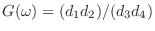
sampling rate) the gain of this two-pole two-zero filter is
. Thus, at the frequency where the arrows in
Fig.8.2 join, (which is slightly less than one-eighth the
sampling rate) the gain of this two-pole two-zero filter is
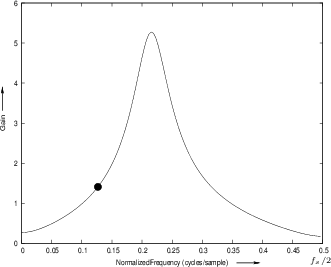
 . Figure 8.3 gives the complete amplitude
response for the poles and zeros shown in Fig.8.2. Before
looking at that, it is a good exercise to try sketching it by
inspection of the pole-zero diagram. It is usually easy to sketch a
qualitatively accurate amplitude-response directly from the poles and
zeros (to within a scale factor).
. Figure 8.3 gives the complete amplitude
response for the poles and zeros shown in Fig.8.2. Before
looking at that, it is a good exercise to try sketching it by
inspection of the pole-zero diagram. It is usually easy to sketch a
qualitatively accurate amplitude-response directly from the poles and
zeros (to within a scale factor).
 |
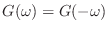 . Thus, plotting the response over positive frequencies only is
sufficient for real filters.
. Thus, plotting the response over positive frequencies only is
sufficient for real filters.
Next Section:
Graphical Phase Response Calculation
Previous Section:
Filter Order = Transfer Function Order