Graphical Phase Response Calculation
The phase response is almost as easy to evaluate graphically as is the amplitude response:
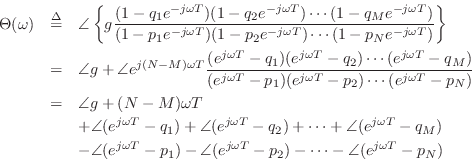
If  is real, then
  is either 0 or
  . Terms of the
form
. Terms of the
form
 can be interpreted as a vector drawn from the point
  to the point
 in the complex plane. The angle of
is
the angle of the constructed vector (where a vector pointing
horizontally to the right has an angle of 0). Therefore, the phase
response at frequency
in the complex plane. The angle of
is
the angle of the constructed vector (where a vector pointing
horizontally to the right has an angle of 0). Therefore, the phase
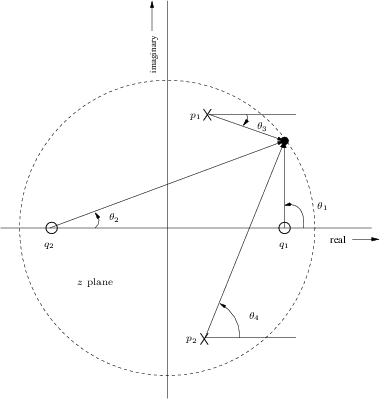
response at frequency  Hz is again obtained by drawing lines from
all the poles and zeros to the point
Hz is again obtained by drawing lines from
all the poles and zeros to the point
 , as shown in
Fig.8.4. The angles of the lines from the zeros are added, and
the angles of the lines from the poles are subtracted. Thus, at the
frequency
, as shown in
Fig.8.4. The angles of the lines from the zeros are added, and
the angles of the lines from the poles are subtracted. Thus, at the
frequency  the phase response of the two-pole two-zero filter
in the figure is
the phase response of the two-pole two-zero filter
in the figure is
 .
.
Note that an additional phase of
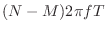 radians appears when
the number of poles is not equal to the number of zeros. This factor
comes from writing the transfer function as
radians appears when
the number of poles is not equal to the number of zeros. This factor
comes from writing the transfer function as

 additional zeros at
  when
when  , or
, or  poles at when
  . Strictly
speaking, every digital filter has an equal number of poles and zeros
when those at and
. Strictly
speaking, every digital filter has an equal number of poles and zeros
when those at and
 are counted. It is customary,
however, when discussing the number of poles and zeros a filter has,
to neglect these, since they correspond to pure delay and do not
affect the amplitude response. Figure 8.5 gives the phase
response for this two-pole two-zero example.
are counted. It is customary,
however, when discussing the number of poles and zeros a filter has,
to neglect these, since they correspond to pure delay and do not
affect the amplitude response. Figure 8.5 gives the phase
response for this two-pole two-zero example.
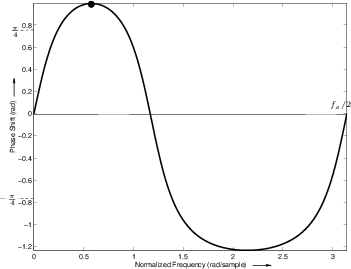 |
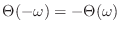 ), so the curve
shown here may be reflected through 0 and negated
to obtain the plot for
), so the curve
shown here may be reflected through 0 and negated
to obtain the plot for
Next Section:
Stability Revisited
Previous Section:
Graphical Computation of Amplitude Response from Poles and Zeros