Low and High Shelving Filters
The analog transfer function for a low shelf is given by [103]

 is the dc boost amount (at
  ), and the high-frequency
gain (
), and the high-frequency
gain ( ) is constrained to be
  . The transition
frequency dividing low and high frequency regions is
. The transition
frequency dividing low and high frequency regions is  .
See
Appendix E for a development of
.
See
Appendix E for a development of  -plane analysis of analog
(continuous-time) filters.
-plane analysis of analog
(continuous-time) filters.
A high shelf is obtained from a low shelf by the conformal mapping
 , which interchanges high and low frequencies, i.e.,

 .
.
To convert these analog-filter transfer functions to digital form, we apply the bilinear transform:
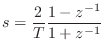
 denotes the sampling interval in seconds.B.5
Low and high shelf filters are typically implemented in series, and are typically used to give a little boost or cut at the extreme low or high end (of the spectrum), respectively. To provide a boost or cut near other frequencies, it is necessary to go to (at least) a second-order section, often called a ``peaking equalizer,'' as described in §B.5 below.
Exercise
Perform the bilinear transform defined above and calculate the
coefficients of a first-order digital low shelving filter. Find the
pole and zero as a function of , , and . Set  and verify that you get a gain of
  . Set
. Set  and verify that
you get a gain of 1 there.
and verify that
you get a gain of 1 there.
Next Section:
Peaking Equalizers
Previous Section:
DC Blocker