Lowpass Filter Design
We have discussed in detail (Chapter 1) the simplest lowpass filter,
 having the transfer function
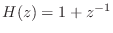 with
one zero at
with
one zero at  and one pole at
  . From the graphical method
for visualizing the amplitude response (§8.2), we see that this
filter totally rejects signal energy at half the sampling rate, while
lower frequencies experience higher gains, reaching a maximum at
. From the graphical method
for visualizing the amplitude response (§8.2), we see that this
filter totally rejects signal energy at half the sampling rate, while
lower frequencies experience higher gains, reaching a maximum at
 . We also see that the pole at has no effect on the
amplitude response.
. We also see that the pole at has no effect on the
amplitude response.
A high quality lowpass filter should look more like the ``box car'' amplitude response shown in Fig.1.1. While it is impossible to achieve this ideal response exactly using a finite-order filter, we can come arbitrarily close. We can expect the amplitude response to improve if we add another pole or zero to the implementation.
Perhaps the best known ``classical'' methods for lowpass filter designs are those derived from analog Butterworth, Chebyshev, and Elliptic Function filters [64]. These generally yield IIR filters with the same number of poles as zeros. When an FIR lowpass filter is desired, different design methods are used, such as the window method [68, p. 88] (Matlab functions fir1 and fir2), Remez exchange algorithm [68, pp. 136-140], [64, pp. 89-106] (Matlab functions remez and cremez), linear programming [93], [68, p. 140], and convex optimization [67]. This section will describe only Butterworth IIR lowpass design in some detail. For the remaining classical cases (Chebyshev, Inverse Chebyshev, and Elliptic), see, e.g., [64, Chapter 7] and/or Matlab/Octave functions butter, cheby1, cheby2, and ellip.
Next Section:
Butterworth Lowpass Design
Previous Section:
Summary