Sign in

username:

password:


Not a member?

Search Online Books


Search tips

Free Online Books


Chapters

Chapter Contents:

Search Introduction to Digital Filters


Book Index | Global Index


Would you like to be notified by email when Julius Orion Smith III publishes a new entry into his blog?


Method

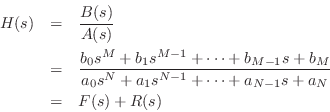
As can be seen from the code listing, this implementation of residuez simply calls residue, which was written to carry out the partial fraction expansions of $ s$-plane (continuous-time) transfer functions $ H(s)$:

\begin{eqnarray*}
H(s) &=& \frac{B(s)}{A(s)}\\
&=& \frac{b_0 s^M + b_1 s^{M-1}...
...s^N + a_1 s^{N-1} + \cdots + a_{N-1}s + a_N}\\
&=& F(s) + R(s)
\end{eqnarray*}

where $ F(s)$ is the ``quotient'' and $ R(s)$ is the ``remainder'' in the PFE:

$\displaystyle F(s)$ $\displaystyle \isdef$ $\displaystyle f_0 s^L + f_1 s^{L-1} + \cdots + f_{L-1} s + f_L$  
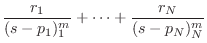
$\displaystyle R(s)$ $\displaystyle \isdef$ $\displaystyle \frac{r_1}{(s-p_1)^m_1} + \cdots + \frac{r_N}{(s-p_N)^m_N}
\protect$ (J.1)

where $ L=M-N$ is the order of the quotient polynomial in $ s$, and $ m_i$ is the multiplicity of the $ i$th pole. (When all poles are distinct, we have $ m_i=1$ for all $ i$.) For $ M<N$, we define $ F(s)=0$.

In the discrete-time case, we have the $ z$-plane transfer function

$\displaystyle H(z)$ $\displaystyle =$ $\displaystyle \frac{B(z)}{A(z)}$  
  $\displaystyle =$ $\displaystyle \frac{b_0 + b_1 z^{-1}+ \cdots + b_{M-1}z^{-(M-1)} + b_M z^{-M}}
{a_0 + a_1 z^{-1}+ \cdots + a_{N-1}z^{-(N-1)} + a_N z^{-N}}.
\protect$ (J.2)

For compatibility with Matlab's residuez, we need a PFE of the form $ H(z)=F(z)+R(z)$ such that
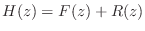
\begin{eqnarray*}
F(z) &\isdef & f_0 + f_1 z^{-1}+ \cdots + f_{L-1} z^{-(L-1)} +...
...c{r_1}{(1-p_1z^{-1})^m_1} + \cdots \frac{r_N}{(1-p_Nz^{-1})^m_N}
\end{eqnarray*}

where $ L=M-N$.

We see that the $ s$-plane case formally does what we desire if we treat $ z$-plane polynomials as polynomials in $ z^{-1}$ instead of $ z$. From Eq.$ \,$(J.2), we see that this requires reversing the coefficient-order of B and A in the call to residue. In the returned result, we obtain terms such as

$\displaystyle \frac{\rho_i}{(s-\pi_i)^{m_i}} \isdef \frac{\rho_i}{(z^{-1}-\pi_i)^{m_i}}
=\frac{(-1)^{m_i}\rho_i \pi_i^{-m_i}}{(1-\pi_i^{-1}z^{-1})^{m_i}}
$

where the second form is simply the desired canonical form for $ z$-plane PFE terms. Thus, the $ i$th pole is

$\displaystyle p_i = \pi_i^{-1}
$

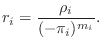
and the $ i$th residue is

$\displaystyle r_i = \frac{\rho_i}{(-\pi_i)^{m_i}}.
$

Finally, the returned quotient polynomial must be flipped for the same reason that the input polynomials needed to be flipped (to convert from left-to-right descending powers of $ z^{-1}$ [$ s$] in the returned result to ascending powers of $ z^{-1}$).


Order a Hardcopy of Introduction to Digital Filters

Previous: Partial Fraction Expansion: residuez.m
Next: Example with Repeated Poles

written by Julius Orion Smith III
Julius Smith's background is in electrical engineering (BS Rice 1975, PhD Stanford 1983). He is presently Professor of Music and Associate Professor (by courtesy) of Electrical Engineering at Stanford's Center for Computer Research in Music and Acoustics (CCRMA), teaching courses and pursuing research related to signal processing applied to music and audio systems. See http://ccrma.stanford.edu/~jos/ for details.


Comments


No comments yet for this page


Add a Comment
You need to login before you can post a comment (best way to prevent spam). ( Not a member? )