







Minimum-Phase/Allpass Decomposition
Every causal stable filter  with no zeros on the unit
circle can be factored into a minimum-phase filter in cascade with a
causal stable allpass filter:
with no zeros on the unit
circle can be factored into a minimum-phase filter in cascade with a
causal stable allpass filter:

 is minimum phase,
  is a stable allpass filter:

 is the number of maximum-phase zeros of .
This result is easy to show by induction. Consider a single
maximum-phase zero  of . Then
 , and
can be written with the maximum-phase zero factored out as
, and
can be written with the maximum-phase zero factored out as

 to get
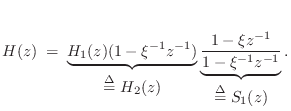 into the product of
  , in which
the maximum-phase zero has been reflected inside the unit
circle to become minimum-phase (from
, in which
the maximum-phase zero has been reflected inside the unit
circle to become minimum-phase (from  to
to  ), times a
stable allpass filter
), times a
stable allpass filter  consisting of the original
maximum-phase zero and a new pole at (which
cancels the reflected zero at given to ). This
procedure can now be repeated for each maximum-phase zero in
.
consisting of the original
maximum-phase zero and a new pole at (which
cancels the reflected zero at given to ). This
procedure can now be repeated for each maximum-phase zero in
.
In summary, we may factor maximum-phase zeros out of the transfer function and replace them with their minimum-phase counterparts without altering the amplitude response. This modification is equivalent to placing a stable allpass filter in series with the original filter, where the allpass filter cancels the maximum-phase zero and introduces the minimum-phase zero.
A procedure for computing the minimum phase for a given spectral magnitude is discussed in §11.7 below. More theory pertaining to minimum phase sequences may be found in [60].
Next Section:
Is Linear Phase Really Ideal for Audio?
Previous Section:
Minimum Phase Means Fastest Decay












