







Multi-Input, Multi-Output (MIMO)
Allpass Filters
To generalize lossless filters to the multi-input, multi-output (MIMO) case, we must generalize conjugation to MIMO transfer function matrices:
Theorem: A  transfer function matrix
 is
lossless if and only if
its frequency-response matrix
is
lossless if and only if
its frequency-response matrix
 is unitary, i.e.,
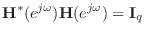
for all
 , where
 denotes the
  identity
matrix, and
identity
matrix, and
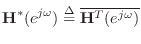
 denotes the Hermitian transpose
(complex-conjugate transpose) of
:
denotes the Hermitian transpose
(complex-conjugate transpose) of
:
Let
 denote the length
  output vector at time
  , and
let
, and
let
 denote the input
  -vector at time . Then in the
frequency domain we have
-vector at time . Then in the
frequency domain we have
 , which
implies
, which
implies
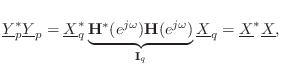
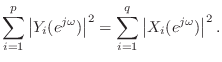 yields that the total energy in equals the total energy out, as
required by the definition of losslessness.
yields that the total energy in equals the total energy out, as
required by the definition of losslessness.
We have thus shown that in the MIMO case, losslessness is equivalent to having a unitary frequency-response matrix. A MIMO allpass filter is therefore any filter with a unitary frequency-response matrix.
Note that
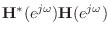 is a matrix product
of a
is a matrix product
of a  times a matrix. If
  , then the rank
must be deficient. Therefore,
, then the rank
must be deficient. Therefore,  . (There must be at least as
many outputs as there are inputs, but it's ok to have extra outputs.)
. (There must be at least as
many outputs as there are inputs, but it's ok to have extra outputs.)
Paraunitary MIMO Filters
In §C.2, we generalized the allpass property
 to the entire complex plane as
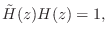
 is defined as the paraconjugate of
  . In the MIMO case,
the paraconjugate is the same, but including a matrix transpose operation:
. In the MIMO case,
the paraconjugate is the same, but including a matrix transpose operation:
MIMO Paraconjugate
Definition:
The paraconjugate of
is defined as
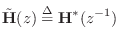
 denotes transpose of
followed by
complex-conjugation of the coefficients within
denotes transpose of
followed by
complex-conjugation of the coefficients within
 (and not the powers of
  ). For example, if
![$\displaystyle \mathbf{H}(z)=\left[\begin{array}{c} 1+jz^{-1} \\ [2pt] 1+z^{-2} \end{array}\right]
$](http://www.dsprelated.com/josimages_new/filters/img1628.png)
![$\displaystyle {\tilde{\mathbf{H}}}(z)=\left[\begin{array}{cc} 1-jz & 1+z^2 \end{array}\right]
$](http://www.dsprelated.com/josimages_new/filters/img1629.png)
MIMO Paraunitary Condition
With the above definition for paraconjugation of a MIMO transfer-function
matrix, we may generalize the MIMO allpass condition Eq. (C.2) to the
entire plane as follows:
(C.2) to the
entire plane as follows:
Theorem:
Every lossless transfer function matrix
is paraunitary,
i.e.,
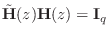
By construction, every paraunitary matrix transfer function is
unitary on the unit circle for all . Away from the
unit circle, the paraconjugate
 is the unique analytic
continuation of
is the unique analytic
continuation of
 (the Hermitian transpose of
).
(the Hermitian transpose of
).
Example:
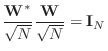
The normalized DFT matrix is an  order zero
paraunitary transformation. This is because the normalized DFT
matrix,
order zero
paraunitary transformation. This is because the normalized DFT
matrix,
![$ \mathbf{W}=[W_N^{nk}]/\sqrt{N},\,n,k=0,\ldots,N-1$](http://www.dsprelated.com/josimages_new/filters/img1633.png) , where
, where
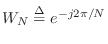 , is a
unitary matrix:
, is a
unitary matrix:
Properties of Paraunitary Systems
Paraunitary systems are essentially multi-input, multi-output (MIMO)
allpass filters. Let
denote the matrix transfer
function of a paraunitary system. Some of its properties include the
following [98]:
- In the square case (
 ), the matrix determinant,
![$ \det[\mathbf{H}(z)]$](http://www.dsprelated.com/josimages_new/filters/img1637.png) , is an allpass filter.
, is an allpass filter.
- Therefore, if a square
contains FIR elements, its
determinant is a simple delay:
![$ \det[\mathbf{H}(z)]=z^{-K}$](http://www.dsprelated.com/josimages_new/filters/img1638.png) for some
integer
for some
integer  .
.
Properties of Paraunitary Filter Banks
An  -channel filter bank can be viewed as an
  MIMO filter
![$\displaystyle \mathbf{H}(z) = \left[\begin{array}{c} H_1(z) \\ [2pt] H_2(z) \\ [2pt] \vdots \\ [2pt] H_N(z)\end{array}\right]
$](http://www.dsprelated.com/josimages_new/filters/img1640.png)
A paraunitary filter bank must therefore obey
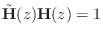
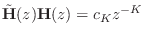 is some nonnegative integer and
  .
.
We can note the following properties of paraunitary filter banks:
- A synthesis filter bank
 corresponding
to analysis filter bank
is defined as that filter bank
which inverts the analysis filter bank, i.e., satisfies
Clearly, not every filter bank will be invertible in this way. When it is, it may be called a perfect reconstruction filter bank. When a filter bank transfer function
corresponding
to analysis filter bank
is defined as that filter bank
which inverts the analysis filter bank, i.e., satisfies
Clearly, not every filter bank will be invertible in this way. When it is, it may be called a perfect reconstruction filter bank. When a filter bank transfer function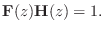 is paraunitary, its
corresponding synthesis filter bank is simply the paraconjugate filter
bank
, or
is paraunitary, its
corresponding synthesis filter bank is simply the paraconjugate filter
bank
, or

- The channel filters
 in a paraunitary filter bank
are power complementary:
This follows immediately from looking at the paraunitary property on the unit circle.
in a paraunitary filter bank
are power complementary:
This follows immediately from looking at the paraunitary property on the unit circle.
- When
is FIR, the corresponding synthesis filter
matrix
is also FIR. Note that this implies an FIR
filter-matrix can be inverted by another FIR filter-matrix. This is in
stark contrast to the case of single-input, single-output FIR filters,
which must be inverted by IIR filters, in general.
- When
is FIR, each synthesis filter,
 , is simply the
  of its corresponding
analysis filter
of its corresponding
analysis filter
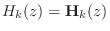 :
where
:
where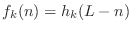
 is the filter length. (When the filter coefficients are
complex, includes a complex conjugation as well.)
is the filter length. (When the filter coefficients are
complex, includes a complex conjugation as well.)
This follows from the fact that paraconjugating an FIR filter amounts to simply flipping (and conjugating) its coefficients.
Note that only trivial FIR filters can be paraunitary in the single-input, single-output (SISO) case. In the MIMO case, on the other hand, paraunitary systems can be composed of FIR filters of any order.
- FIR analysis and synthesis filters in paraunitary filter banks
have the same amplitude response.
This follows from the fact that
 , i.e., flipping an FIR filter impulse response
  conjugates the frequency response, which does not affect its amplitude
response
conjugates the frequency response, which does not affect its amplitude
response
 .
.
Paraunitary Filter Examples
The Haar filter bank is defined as
![$\displaystyle \mathbf{H}(z) = \frac{1}{\sqrt{2}}\left[\begin{array}{c} 1+z^{-1} \\ [2pt] 1-z^{-1} \end{array}\right]
$](http://www.dsprelated.com/josimages_new/filters/img1655.png) is
is
![$\displaystyle {\tilde{\mathbf{H}}}(z) = \left[\begin{array}{cc} 1+z & 1 - z \end{array}\right] / \sqrt{2}
$](http://www.dsprelated.com/josimages_new/filters/img1656.png)
![$\displaystyle {\tilde{\mathbf{H}}}(z) \mathbf{H}(z) = \left[\begin{array}{cc} 1...
...ight] \left[\begin{array}{c} 1+z^{-1} \\ [2pt] 1-z^{-1} \end{array}\right]
= 1
$](http://www.dsprelated.com/josimages_new/filters/img1657.png) is ,
power-complementary and paraunitary are the same property.
is ,
power-complementary and paraunitary are the same property.
For more about paraunitary filter banks, see Chapter 6 of [98].
Next Section:
Allpass Problems
Previous Section:
Paraunitary FiltersC.4












