A Musical Time-Varying Filter Example
Note, however, that a gain  may vary with time independently
of
may vary with time independently
of  to yield a linear time-varying filter. In this case,
linearity may be demonstrated by verifying
to yield a linear time-varying filter. In this case,
linearity may be demonstrated by verifying
![$\displaystyle g(n) \left[ \alpha \cdot x_1(n) + \beta \cdot x_2(n)\right]
= \alpha \cdot [g(n)\cdot x_1(n)] + \beta\cdot[g(n)\cdot x_2(n)]
$](http://www.dsprelated.com/josimages_new/filters/img495.png)
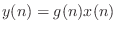 . For example,
![$ g(n) = 1
+ \cos[2\pi (4)nT]$](http://www.dsprelated.com/josimages_new/filters/img497.png) would give a maximally deep tremolo with 4 swells
per second.
would give a maximally deep tremolo with 4 swells
per second.
Next Section:
Analysis of Nonlinear Filters
Previous Section:
Nonlinear Filter Example: Dynamic Range Compression