One-Zero
 .
.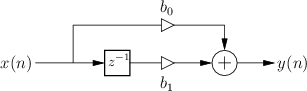
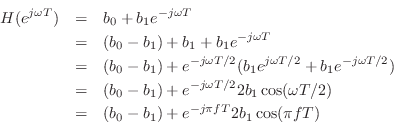
Figure B.1 gives the signal flow graph for the general one-zero filter. The frequency response for the one-zero filter may be found by the following steps:

By factoring out
 from the frequency response, to
balance the exponents of
from the frequency response, to
balance the exponents of  , we can get this closer to polar form as
follows:
, we can get this closer to polar form as
follows:
 |

We now apply the general equations given in
Chapter 7 for filter gain  and filter phase
 as a function of frequency:
![\begin{eqnarray*}
H(e^{j\omega T}) &=& b_0 + b_1e^{-j\omega T}\\
&=& b_0 + b_1...
...left[\frac{-b_1 \sin(\omega T)}{b_0 + b_1 \cos(\omega T)}\right]
\end{eqnarray*}](http://www.dsprelated.com/josimages_new/filters/img1343.png)
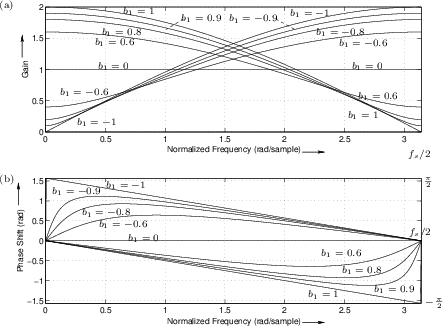
A plot of and
for  and various
real values of
and various
real values of  , is given in Fig.B.2. The filter has a zero
at
, is given in Fig.B.2. The filter has a zero
at
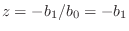 in the
  plane, which is always on the
real axis. When a point on the unit circle comes close to the zero of
the transfer function the filter gain at that frequency is
low. Notice that one real zero can basically make either a highpass
(
plane, which is always on the
real axis. When a point on the unit circle comes close to the zero of
the transfer function the filter gain at that frequency is
low. Notice that one real zero can basically make either a highpass
(
 ) or a lowpass filter (
 ). For the phase
response calculation using the graphical method, it is necessary to
include the pole at
). For the phase
response calculation using the graphical method, it is necessary to
include the pole at  .
.
Next Section:
One-Pole
Previous Section:
Phasor Analysis: Factoring a Complex Sinusoid into Phasor Times Carrier