Sign in

username:

password:


Not a member?

Search Online Books


Search tips

Free Online Books

Sponsor

Industry's highest performing at the lowest power DSPs now as low as $5.00*
Start development today!
*volume pricing for 10ku

Chapters

See Also

Embedded SystemsFPGAElectronics
Chapter Contents:

Search Introduction to Digital Filters


Book Index | Global Index


Would you like to be notified by email when Julius Orion Smith III publishes a new entry into his blog?


Paraunitary FiltersC.4

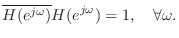
Another way to express the allpass condition $ \left\vert H(e^{j\omega})\right\vert=1$ is to write

$\displaystyle \overline{H(e^{j\omega})} H(e^{j\omega}) = 1, \quad\forall\omega.
$

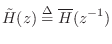
This form generalizes by analytic continuation (see §D.2) to $ {\tilde H}(z)H(z)$ over the entire the $ z$ plane, where $ {\tilde H}(z)$ denotes the paraconjugate of $ H(z)$:


Definition: The paraconjugate of a transfer function may be defined as the analytic continuation of the complex conjugate from the unit circle to the whole $ z$ plane:

$\displaystyle {\tilde H}(z) \isdef \overline{H}(z^{-1})
$

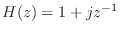
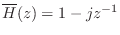
where $ \overline{H}(z)$ denotes complex conjugation of the coefficients only of $ H(z)$ and not the powers of $ z$. For example, if $ H(z)=1+jz^{-1}$, then $ \overline{H}(z) = 1-jz^{-1}$. We can write, for example,

$\displaystyle \overline{H}(z) \isdef \overline{H\left(\overline{z}\right)}
$

in which the conjugation of $ z$ serves to cancel the outer conjugation.


Examples:

  • $ H(z)=1+z^{-1}\quad\Rightarrow\quad {\tilde H}(z)=1+z$
  • $ H(z)=1+2jz^{-1}+3z^{-2}\quad\Rightarrow\quad {\tilde H}(z)=1-2jz+3z^2$

We refrain from conjugating $ z$ in the definition of the paraconjugate because $ \overline{z}$ is not analytic in the complex-variables sense. Instead, we invert $ z$, which is analytic, and which reduces to complex conjugation on the unit circle.

The paraconjugate may be used to characterize allpass filters as follows:


Theorem: A causal, stable, filter $ H(z)$ is allpass if and only if

$\displaystyle {\tilde H}(z) H(z) = 1
$

Note that this is equivalent to the previous result on the unit circle since

$\displaystyle {\tilde H}(e^{j\omega}) H(e^{j\omega}) \isdef \overline{H}(1/e^{j\omega})H(e^{j\omega}) = \overline{H(e^{j\omega})}H(e^{j\omega})
$


Previous: Allpass Examples
Next: Multi-Input, Multi-Output (MIMO) Allpass Filters

Order a Hardcopy of Introduction to Digital Filters


About the Author: Julius Orion Smith III
Julius Smith's background is in electrical engineering (BS Rice 1975, PhD Stanford 1983). He is presently Professor of Music and Associate Professor (by courtesy) of Electrical Engineering at Stanford's Center for Computer Research in Music and Acoustics (CCRMA), teaching courses and pursuing research related to signal processing applied to music and audio systems. See http://ccrma.stanford.edu/~jos/ for details.


Comments


No comments yet for this page


Add a Comment
You need to login before you can post a comment (best way to prevent spam). ( Not a member? )