







Phase and Group Delay
In the previous sections we looked at the two most important
frequency-domain representations for LTI digital filters, the transfer
function  and the frequency response:
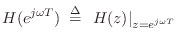
 , thereby breaking it down into
the amplitude response
, thereby breaking it down into
the amplitude response  times the phase-response term
 .
.
In the next two sections we look at two alternative forms of the phase response: phase delay and group delay. After considering some examples and special cases, poles and zeros of the transfer function are discussed in the next chapter.
Phase Delay
The phase response
 of an LTI filter gives the radian
phase shift added to the phase of each sinusoidal component of the
input signal. It is often more intuitive to consider instead the
phase delay, defined as
of an LTI filter gives the radian
phase shift added to the phase of each sinusoidal component of the
input signal. It is often more intuitive to consider instead the
phase delay, defined as
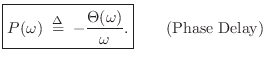
 , which corresponds to a phase
delay
, which corresponds to a phase
delay
 , or one-half sample. Thus, we can say
precisely that the filter
, or one-half sample. Thus, we can say
precisely that the filter
 exhibits half a sample of
time delay at every frequency. (Regarding the discussion in
§1.3.2, it is now obvious how we should define the filter phase
response at frequencies 0 and
exhibits half a sample of
time delay at every frequency. (Regarding the discussion in
§1.3.2, it is now obvious how we should define the filter phase
response at frequencies 0 and  .)
.)
From a sinewave-analysis point of view, if the input to a filter with
frequency response
is
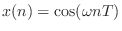
![\begin{eqnarray*}
y(n) &=& G(\omega) \cos[\omega nT + \Theta(\omega)]\\
&=& G(\omega) \cos\{\omega[nT - P(\omega)]\}
\end{eqnarray*}](http://www.dsprelated.com/josimages_new/filters/img889.png)
and it can be clearly seen in this form that the phase delay expresses the phase response as a time delay in seconds.
Phase Unwrapping
In working with phase delay, it is often necessary to ``unwrap''
the phase response
. Phase unwrapping ensures that
all appropriate multiples of  have been included in
. We defined
simply as the complex
angle of the frequency response
have been included in
. We defined
simply as the complex
angle of the frequency response
 , and this is not sufficient
for obtaining a phase response which can be converted to true time
delay. If multiples of are discarded, as is done in the
definition of complex angle, the phase delay is modified by multiples
of the sinusoidal period. Since LTI filter analysis is based on
sinusoids without beginning or end, one cannot in principle
distinguish between ``true'' phase delay and a phase delay with
discarded sinusoidal periods when looking at a sinusoidal output at
any given frequency. Nevertheless, it is often useful to define the
filter phase response as a continuous function of frequency
with the property that
, and this is not sufficient
for obtaining a phase response which can be converted to true time
delay. If multiples of are discarded, as is done in the
definition of complex angle, the phase delay is modified by multiples
of the sinusoidal period. Since LTI filter analysis is based on
sinusoids without beginning or end, one cannot in principle
distinguish between ``true'' phase delay and a phase delay with
discarded sinusoidal periods when looking at a sinusoidal output at
any given frequency. Nevertheless, it is often useful to define the
filter phase response as a continuous function of frequency
with the property that
 or
or  (for real filters). This
specifies how to unwrap the phase response at all frequencies
where the amplitude response is finite and nonzero. When the
amplitude response goes to zero or infinity at some frequency, we can
try to take a limit from below and above that frequency.
(for real filters). This
specifies how to unwrap the phase response at all frequencies
where the amplitude response is finite and nonzero. When the
amplitude response goes to zero or infinity at some frequency, we can
try to take a limit from below and above that frequency.
Matlab and Octave have a function called unwrap() which
implements a numerical algorithm for phase unwrapping.
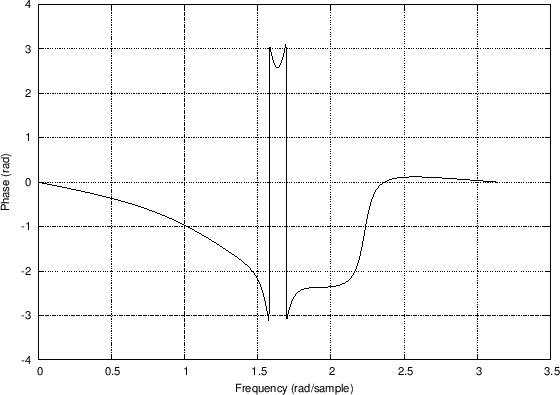
Figures 7.6.2 and 7.6.2 show the effect of the
unwrap function on the phase response of the example elliptic
lowpass filter of §7.5.2, modified to contract the zeros from
the unit circle to a circle of radius  in the
  plane:
  [B,A] = ellip(4,1,20,0.5); % design lowpass filter
   B = B .* (0.95).^[1:length(B)]; % contract zeros by 0.95
  [H,w] = freqz(B,A);      % frequency response
  theta = angle(H);        % phase response
  thetauw = unwrap(theta); % unwrapped phase response
In Fig.7.6.2, the phase-response minimum has ``wrapped around'' to the top of the plot. In Fig.7.6.2, the phase response is continuous. We have contracted the zeros away from the unit circle in this example, because the phase response really does switch discontinuously by
radians when frequency passes through
a point where the phases crosses zero along the unit circle (see
Fig.7.3(b)). The unwrap function need not modify
these discontinuities, but it is free to add or subtract any integer
multiple of in order to obtain the ``best looking''
discontinuity. Typically, for best results, such discontinuities
should alternate between  and
and  , making the phase
response resemble a distorted ``square wave'', as in Fig.7.3(b).
A more precise example appears in Fig.10.2.
, making the phase
response resemble a distorted ``square wave'', as in Fig.7.3(b).
A more precise example appears in Fig.10.2.
Phase
Response 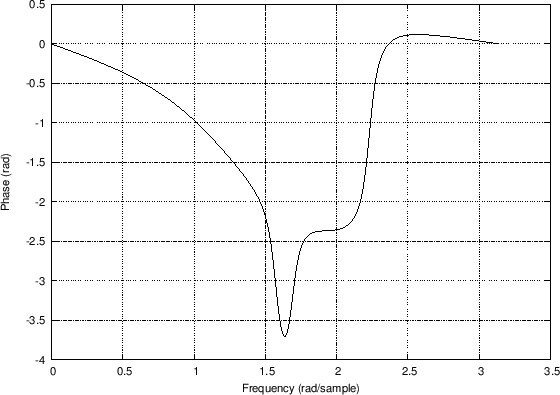
Unwrapped Response
|
 .
.
Group Delay
A more commonly encountered representation of filter phase response is called the group delay, defined by
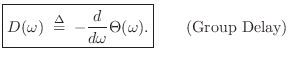
 for
some constant
for
some constant  , the group delay and the phase delay are
identical, and each may be interpreted as time delay (equal to
samples when
, the group delay and the phase delay are
identical, and each may be interpreted as time delay (equal to
samples when
![$ \omega\in[-\pi,\pi]$](http://www.dsprelated.com/josimages_new/filters/img899.png) ). If the phase response
is nonlinear, then the relative phases of the sinusoidal signal
components are generally altered by the filter. A nonlinear phase
response normally causes a ``smearing'' of attack transients such as
in percussive sounds. Another term for this type of phase distortion
is phase dispersion. This can be seen below in §7.6.5.
). If the phase response
is nonlinear, then the relative phases of the sinusoidal signal
components are generally altered by the filter. A nonlinear phase
response normally causes a ``smearing'' of attack transients such as
in percussive sounds. Another term for this type of phase distortion
is phase dispersion. This can be seen below in §7.6.5.
An example of a linear phase response is that of the simplest lowpass
filter,
 . Thus, both the phase delay and the group
delay of the simplest lowpass filter are equal to half a sample at
every frequency.
. Thus, both the phase delay and the group
delay of the simplest lowpass filter are equal to half a sample at
every frequency.
For any reasonably smooth phase function, the group delay  may be interpreted as the time delay of the amplitude envelope
of a sinusoid at frequency
may be interpreted as the time delay of the amplitude envelope
of a sinusoid at frequency  [63]. The bandwidth of
the amplitude envelope in this interpretation must be restricted to a
frequency interval over which the phase response is approximately
linear. We derive this result in the next subsection.
[63]. The bandwidth of
the amplitude envelope in this interpretation must be restricted to a
frequency interval over which the phase response is approximately
linear. We derive this result in the next subsection.
Thus, the name ``group delay'' for refers to the fact that
it specifies the delay experienced by a narrow-band ``group'' of
sinusoidal components which have frequencies within a narrow frequency
interval about . The width of this interval is limited to
that over which is approximately constant.
Derivation of Group Delay as Modulation Delay
Suppose we write a narrowband signal centered at frequency  as
as
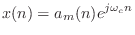
where
is defined as the carrier frequency (in
radians per sample), and  is some ``lowpass'' amplitude
modulation signal. The modulation
is some ``lowpass'' amplitude
modulation signal. The modulation  can be complex-valued to
represent either phase or amplitude modulation or both. By
``lowpass,'' we mean that the spectrum of is concentrated
near dc, i.e.,
can be complex-valued to
represent either phase or amplitude modulation or both. By
``lowpass,'' we mean that the spectrum of is concentrated
near dc, i.e.,

 . The modulation bandwidth is thus
bounded by
. The modulation bandwidth is thus
bounded by
 .
.
Using the above frequency-domain expansion of ,  can be
written as
can be
written as
![$\displaystyle x(n) \eqsp a_m(n) e^{j\omega_c n} \eqsp
\left[\frac{1}{2\pi} \int_{-\epsilon}^{\epsilon} A_m(\omega)e^{j\omega n} d\omega\right] e^{j\omega_c n},
$](http://www.dsprelated.com/josimages_new/filters/img908.png)
 near 0. Let us now pass the frequency component
 through an LTI filter having frequency response
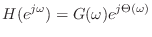
![$\displaystyle y_\omega(n) = \left[G(\omega_c+\omega)A_m(\omega)\right] e^{j[(\omega_c +\omega) n + \Theta(\omega_c+\omega)]}. \protect$](http://www.dsprelated.com/josimages_new/filters/img912.png)
Assuming the phase response
is approximately linear
over the narrow frequency interval
![$ \omega\in[\omega_c-\epsilon,\omega_c+\epsilon]$](http://www.dsprelated.com/josimages_new/filters/img913.png) , we can write
, we can write

 is the filter group delay at .
Making this substitution in Eq.
is the filter group delay at .
Making this substitution in Eq. (7.7) gives
![\begin{eqnarray*}
y_\omega(n)
&=& \left[G(\omega_c+\omega)A_m(\omega)\right]
e^...
...\right]
e^{j\omega[n-D(\omega_c)]} e^{j\omega_c[n-P(\omega_c)]},
\end{eqnarray*}](http://www.dsprelated.com/josimages_new/filters/img916.png)
where we also used the definition of phase delay,
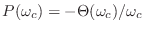 , in the last step. In this expression we
can already see that the carrier sinusoid is delayed by the phase
delay, while the amplitude-envelope frequency-component is delayed by
the group delay. Integrating over to recombine the
sinusoidal components (i.e., using a Fourier superposition integral for
, in the last step. In this expression we
can already see that the carrier sinusoid is delayed by the phase
delay, while the amplitude-envelope frequency-component is delayed by
the group delay. Integrating over to recombine the
sinusoidal components (i.e., using a Fourier superposition integral for
 ) gives
![\begin{eqnarray*}
y(n) &=& \frac{1}{2\pi}\int_{\omega} y_\omega(n) d\omega \\
&...
...)]}\\
&=& a^f[n-D(\omega_c)] \cdot e^{j\omega_c[n-P(\omega_c)]}
\end{eqnarray*}](http://www.dsprelated.com/josimages_new/filters/img918.png)
where  denotes a zero-phase filtering of the amplitude
envelope
denotes a zero-phase filtering of the amplitude
envelope  by
by
 . We see that the amplitude
modulation is delayed by
while the carrier wave is
delayed by
. We see that the amplitude
modulation is delayed by
while the carrier wave is
delayed by
 .
.
We have shown that, for narrowband signals expressed as in
Eq.(7.6) as a modulation envelope times a sinusoidal carrier, the
carrier wave is delayed by the filter phase delay, while the
modulation is delayed by the filter group delay, provided that the
filter phase response is approximately linear over the narrowband
frequency interval.
Group Delay Examples in Matlab
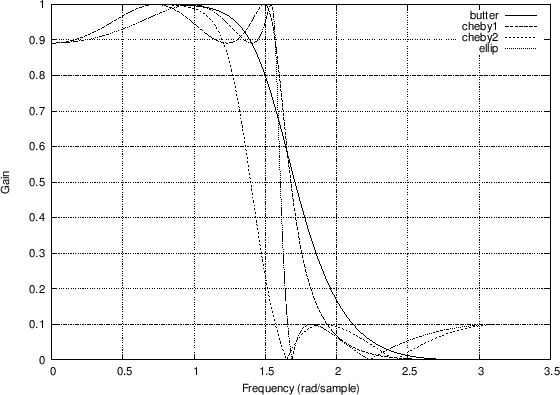
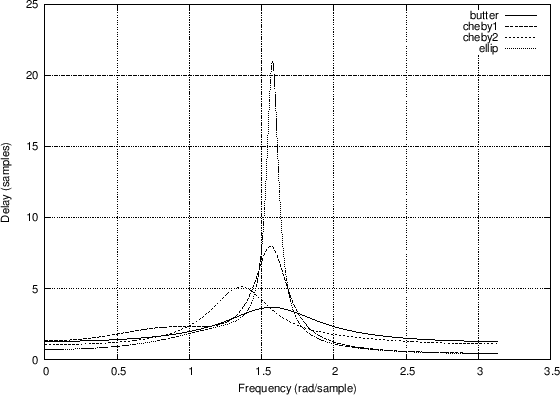
Figure 7.6 compares the group delay responses for a number of classic lowpass filters, including the example of Fig.7.2. The matlab code is listed in Fig.7.5. See, e.g., Parks and Burrus [64] for a discussion of Butterworth, Chebyshev, and Elliptic Function digital filter design. See also §I.2 for details on the Butterworth case. The various types may be summarized as follows:
- Butterworth filters are maximally flat in middle of the passband.
- Chebyshev Type I filters are ``equiripple'' in the passband and ``Butterworth'' in the stopband.
- Chebyshev Type II filters are ``Butterworth'' in the passband and equiripple in the stopband.
- Elliptic function filters are equiripple in both the passband and stopband.
As Fig.7.6.4 indicates, and as is well known, the Butterworth filter has the flattest group delay curve (and most gentle transition from passband to stopband) for the four types compared. The elliptic function filter has the largest amount of ``delay distortion'' near the cut-off frequency (passband edge frequency). Fundamentally, the more abrupt the transition from passband to stopband, the greater the delay-distortion across that transition, for any minimum-phase filter. (Minimum-phase filters are introduced in Chapter 11.) The delay-distortion can be compensated by delay equalization, i.e., adding delay at other frequencies in order approach an overall constant group delay versus frequency. Delay equalization is typically carried out using an allpass filter (defined in §B.2) in series with the filter to be delay-equalized [1].
[Bb,Ab] = butter(4,0.5); % order 4, cutoff at 0.5 * pi Hb=freqz(Bb,Ab); Db=grpdelay(Bb,Ab); [Bc1,Ac1] = cheby1(4,1,0.5); % 1 dB passband ripple Hc1=freqz(Bc1,Ac1); Dc1=grpdelay(Bc1,Ac1); [Bc2,Ac2] = cheby2(4,20,0.5); % 20 dB stopband attenuation Hc2=freqz(Bc2,Ac2); Dc2=grpdelay(Bc2,Ac2); [Be,Ae] = ellip(4,1,20,0.5); % like cheby1 + cheby2 He=freqz(Be,Ae); [De,w]=grpdelay(Be,Ae); figure(1); plot(w,abs([Hb,Hc1,Hc2,He])); grid('on'); xlabel('Frequency (rad/sample)'); ylabel('Gain'); legend('butter','cheby1','cheby2','ellip'); saveplot('../eps/grpdelaydemo1.eps'); figure(2); plot(w,[Db,Dc1,Dc2,De]); grid('on'); xlabel('Frequency (rad/sample)'); ylabel('Delay (samples)'); legend('butter','cheby1','cheby2','ellip'); saveplot('../eps/grpdelaydemo2.eps'); |
Group Delays
|
Vocoder Analysis
The definitions of phase delay and group delay apply quite naturally to the analysis of the vocoder (``voice coder'') [21,26,54,76]. The vocoder provides a bank of bandpass filters which decompose the input signal into narrow spectral ``slices.'' This is the analysis step. For synthesis (often called additive synthesis), a bank of sinusoidal oscillators is provided, having amplitude and frequency control inputs. The oscillator frequencies are tuned to the filter center frequencies, and the amplitude controls are driven by the amplitude envelopes measured in the filter-bank analysis. (Typically, some data reduction or envelope modification has taken place in the amplitude envelope set.) With these oscillators, the band slices are independently regenerated and summed together to resynthesize the signal.
Suppose we excite only channel  of the vocoder with the input signal

 is the center frequency of the channel in radians per
second,
is the center frequency of the channel in radians per
second,  is the sampling interval in seconds, and the bandwidth of
 is smaller than the channel bandwidth. We may regard this
input signal as an amplitude modulated sinusoid. The component
is smaller than the channel bandwidth. We may regard this
input signal as an amplitude modulated sinusoid. The component
 can be called the carrier wave, while
 is the amplitude envelope.
If the phase of each channel filter is linear in frequency within the
passband (or at least across the width of the spectrum
 of
), and if each channel filter has a flat amplitude response in
its passband, then the filter output will be, by the analysis of the
previous section,
of
), and if each channel filter has a flat amplitude response in
its passband, then the filter output will be, by the analysis of the
previous section,
![$\displaystyle y_k(n) \;\approx\; a[nT - D(\omega_k)] \cos\{\omega_k[nT - P(\omega_k)]\} \protect$](http://www.dsprelated.com/josimages_new/filters/img930.png)
where
 is the phase delay of the channel filter at
frequency , and
is the phase delay of the channel filter at
frequency , and
 is the group delay at that
frequency. Thus, in vocoder analysis for additive synthesis, the
phase delay of the analysis filter bank gives the time delay
experienced by the oscillator carrier waves, while the group delay of
the analysis filter bank gives the time delay imposed on the estimated
oscillator amplitude-envelope functions.
is the group delay at that
frequency. Thus, in vocoder analysis for additive synthesis, the
phase delay of the analysis filter bank gives the time delay
experienced by the oscillator carrier waves, while the group delay of
the analysis filter bank gives the time delay imposed on the estimated
oscillator amplitude-envelope functions.
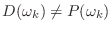
Note that a nonlinear phase response generally results in
 , and
, and
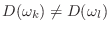 for
for
 . As a result, the dispersive nature of additive synthesis
reconstruction in this case can be seen in Eq.(7.8).
. As a result, the dispersive nature of additive synthesis
reconstruction in this case can be seen in Eq.(7.8).
Numerical Computation of Group Delay
The definition of group delay,

A more useful form of the group delay arises from the
logarithmic derivative of the frequency response. Expressing
the frequency response
in polar form as
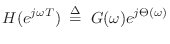

Since differentiation is linear, the logarithmic derivative becomes
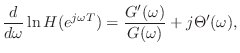
 and
and
 denote the
derivatives of and
, respectively, with
respect to . We may therefore express the group delay as
denote the
derivatives of and
, respectively, with
respect to . We may therefore express the group delay as
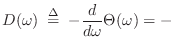 im
im im
im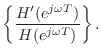
 , with

In this case, the derivative is simply
![\begin{eqnarray*}
B^\prime(e^{j\omega T}) &\isdef & \frac{d}{d\omega}\left[b_0
...
...b_M e^{-jM\omega T}\right]\\
&\isdef & -jT\,B_r(e^{j\omega T}),
\end{eqnarray*}](http://www.dsprelated.com/josimages_new/filters/img947.png)
where  denotes ``
 ramped'', i.e., the
  th coefficient of
the polynomial
th coefficient of
the polynomial  is
is  , for
, for
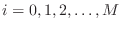 . In
matlab, we may compute Br from B via the
following statement:
. In
matlab, we may compute Br from B via the
following statement:
Br = B .* [0:M]; % Compute ramped B polynomialThe group delay of an FIR filter
 can now
be written as
can now
be written as
 im
im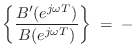 im
im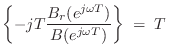 re
re
D = real(fft(Br) ./ fft(B))where the fft, of course, approximates the Discrete Time Fourier Transform (DTFT). Such sampling of the frequency axis by this approximation is information-preserving whenever the number of samples (FFT length) exceeds the polynomial order
 . The ratio of
sampled DTFTs, however, is undersampled, in general. In fact,
we may have
. The ratio of
sampled DTFTs, however, is undersampled, in general. In fact,
we may have
 at some frequencies (``zeros on the unit
circle''). The grpdelay matlab utility in §J.8
watches out for division by zero, and simply sets the group delay to
zero at such frequencies. Note that the true group delay approaches
infinite magnitude as either a zero or pole approaches the unit circle.
at some frequencies (``zeros on the unit
circle''). The grpdelay matlab utility in §J.8
watches out for division by zero, and simply sets the group delay to
zero at such frequencies. Note that the true group delay approaches
infinite magnitude as either a zero or pole approaches the unit circle.
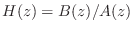
Finally, when there are both poles and zeros, we have
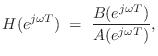
 is given in Eq.(7.9), and

Straightforward differentiation yields
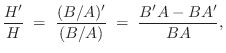
and this can be implemented analogous to the FIR case discussed above. However, a faster algorithm (usually) results from converting the IIR case to the FIR case:
![$\displaystyle C(z) \isdefs B(z)\left[ z^{-N}\overline{A}(1/z)\right] \isdefs B(z)\tilde{A}(z) \protect$](http://www.dsprelated.com/josimages_new/filters/img961.png)
where
![$\displaystyle \tilde{A}(z)\isdefs z^{-N}\overline{A}(1/z) \eqsp
[\overline{a}_...
..._{N-1}z^{-1},\overline{a}_{N-2}z^{-2},\ldots,\overline{a}_1 z^{-(N-1)}+z^{-N}]
$](http://www.dsprelated.com/josimages_new/filters/img962.png)
 .8.4In matlab, the C polynomial is given by
C = conv(B,fliplr(conj(A)));It is straightforward to show (Problem 11) that

 is therefore
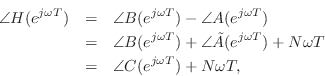
and the group delay computation thus reduces to the FIR case:
 re
re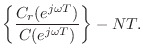
Next Section:
Frequency Response Analysis Problems
Previous Section:
Frequency Response as a Ratio of DTFTs












