Poles of a State Space Filter
In this section, we show that the poles of a state-space model are given
by the eigenvalues of the state-transition matrix  .
.
Beginning again with the transfer function of the general state-space model,

 are either the same as
or some subset of the poles of
are either the same as
or some subset of the poles of
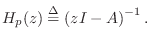
 is given by the determinant
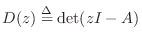
 denotes the determinant of the square matrix
 . (The determinant of is also often written
 .)
In linear algebra, the polynomial
.)
In linear algebra, the polynomial
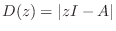 is called the
characteristic polynomial for the matrix .
The roots of the characteristic polynomial are called the
eigenvalues of .
is called the
characteristic polynomial for the matrix .
The roots of the characteristic polynomial are called the
eigenvalues of .
Thus, the eigenvalues of the state transition matrix are the
poles of the corresponding linear time-invariant system. In
particular, note that the poles of the system do not depend on the
matrices  , although these matrices, by placing system zeros,
can cause pole-zero cancellations (unobservable or uncontrollable
modes).
, although these matrices, by placing system zeros,
can cause pole-zero cancellations (unobservable or uncontrollable
modes).
Next Section:
Difference Equations to State Space
Previous Section:
Transposition of a State Space Filter