Prony's Method
There are several variations on equation-error minimization, and some
confusion in terminology exists. We use the definition of Prony's
method given by Markel and Gray [48]. It is equivalent to ``Shank's
method'' [9]. In this method, one first computes the
denominator
 by minimizing
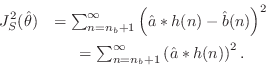
This step is equivalent to minimization of ratio error
(as used in linear prediction) for the
all-pole part
 , with the first
  terms of the time-domain
error sum discarded (to get past the influence of the zeros
on the impulse response). When
terms of the time-domain
error sum discarded (to get past the influence of the zeros
on the impulse response). When
 , it coincides with the
covariance method of linear prediction [48,47]. This idea for
finding the poles by ``skipping'' the influence of the zeros on the
impulse-response shows up in the stochastic case under the name of modified Yule-Walker equations [11].
, it coincides with the
covariance method of linear prediction [48,47]. This idea for
finding the poles by ``skipping'' the influence of the zeros on the
impulse-response shows up in the stochastic case under the name of modified Yule-Walker equations [11].
Now, Prony's method consists of next minimizing  output error
with the pre-assigned poles given by
. In other words, the
numerator
output error
with the pre-assigned poles given by
. In other words, the
numerator
 is found by minimizing
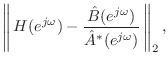
 is now known. This hybrid method is not as sensitive
to the time distribution of
is now known. This hybrid method is not as sensitive
to the time distribution of  as is the pure equation-error method.
In particular, the degenerate equation-error
example above (in which
as is the pure equation-error method.
In particular, the degenerate equation-error
example above (in which
 was
obtained) does not fare so badly using Prony's method.
was
obtained) does not fare so badly using Prony's method.
Next Section:
The Padé-Prony Method
Previous Section:
An FFT-Based Equation-Error Method