Real Second-Order Sections
In practice, however, signals are typically real-valued functions of
time. As a result, for real filters (§5.1),
it is typically more efficient computationally to combine
complex-conjugate one-pole sections together to form real second-order
sections (two poles and one zero each, in general). This process was
discussed in §6.8.1, and the resulting transfer function of
each second-order section becomes
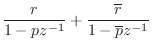

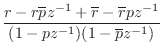
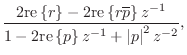
where
 is one of the poles, and
  is its corresponding residue.
This is a special case of the biquad section discussed in
§B.1.6.
is its corresponding residue.
This is a special case of the biquad section discussed in
§B.1.6.
When the two poles of a real second-order section are complex, they
form a complex-conjugate pair, i.e., they are located at
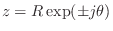 in the
  plane, where
  is the modulus of either
pole, and
is the modulus of either
pole, and  is the angle of either pole. In this case, the
``resonance-tuning coefficient'' in Eq.
is the angle of either pole. In this case, the
``resonance-tuning coefficient'' in Eq. (9.3) can be expressed as


Figures 3.25 and 3.26 (p. ![[*]](../icons/crossref.png) ) illustrate filter realizations
consisting of one first-order and two second-order filter sections in
parallel.
) illustrate filter realizations
consisting of one first-order and two second-order filter sections in
parallel.
Next Section:
Implementation of Repeated Poles
Previous Section:
First-Order Complex Resonators