Sign in

username:

password:


Not a member?

Search Online Books


Search tips

Free Online Books

Ads

Chapters

Chapter Contents:

Search Introduction to Digital Filters


Book Index | Global Index


Would you like to be notified by email when Julius Orion Smith III publishes a new entry into his blog?


Relation to the z Transform

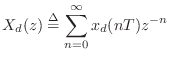
The Laplace transform is used to analyze continuous-time systems. Its discrete-time counterpart is the $ z$ transform:

$\displaystyle X_d(z) \isdef \sum_{n=0}^\infty x_d(nT) z^{-n}
$

If we define $ z=e^{sT}$, the $ z$ transform becomes proportional to the Laplace transform of a sampled continuous-time signal:
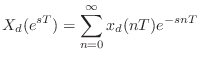
$\displaystyle X_d(e^{sT}) = \sum_{n=0}^\infty x_d(nT) e^{-snT}
$

As the sampling interval $ T$ goes to zero, we have

$\displaystyle \lim_{T\to 0}
X_d(e^{sT})T =
\lim_{\Delta t\to 0}
\sum_{n=0}^\infty x_d(t_n) e^{-st_n} \Delta t
= \int_{0}^\infty x_d(t) e^{-st} dt
\isdef X(s)
$

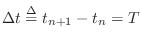
where $ t_n\isdef nT$ and $ \Delta t \isdef t_{n+1} - t_n = T$.

In summary,

$\textstyle \parbox{0.8\textwidth}{the {\it z} transform\ (times the sampling in...
...o0$, the Laplace transform\ of
the underlying continuous-time signal $x_d(t)$.}$

Note that the $ z$ plane and $ s$ plane are generally related by

$\displaystyle \zbox {z = e^{sT}.}
$

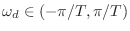
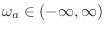
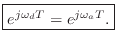
In particular, the discrete-time frequency axis $ \omega_d \in(-\pi/T,\pi/T)$ and continuous-time frequency axis $ \omega_a \in(-\infty,\infty)$ are related by

$\displaystyle \zbox {e^{j\omega_d T} = e^{j\omega_a T}.}
$

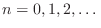
For the mapping $ z=e^{sT}$ from the $ s$ plane to the $ z$ plane to be invertible, it is necessary that $ X(j\omega_a )$ be zero for all $ \vert\omega_a \vert\geq \pi/T$. If this is true, we say $ x(t)$ is bandlimited to half the sampling rate. As is well known, this condition is necessary to prevent aliasing when sampling the continuous-time signal $ x(t)$ at the rate $ f_s=1/T$ to produce $ x(nT)$, $ n=0,1,2,\ldots\,$ (see [84, Appendix G]).


Order a Hardcopy of Introduction to Digital Filters

Previous: Analytic Continuation
Next: Laplace Transform Theorems

written by Julius Orion Smith III
Julius Smith's background is in electrical engineering (BS Rice 1975, PhD Stanford 1983). He is presently Professor of Music and Associate Professor (by courtesy) of Electrical Engineering at Stanford's Center for Computer Research in Music and Acoustics (CCRMA), teaching courses and pursuing research related to signal processing applied to music and audio systems. See http://ccrma.stanford.edu/~jos/ for details.


Comments


No comments yet for this page


Add a Comment
You need to login before you can post a comment (best way to prevent spam). ( Not a member? )