A Short-Cut to Controller Canonical Form
When converting a transfer function to state-space form by hand, the
step of pulling out the direct path, like we did in going from
Eq. (G.13) to Eq.(G.14), can be bypassed [28, p.
87].
(G.13) to Eq.(G.14), can be bypassed [28, p.
87].
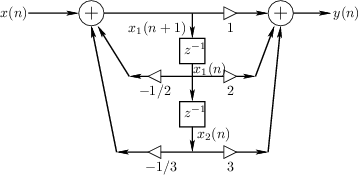 |
Figure G.2 gives the standard direct-form-II structure for a second-order
IIR filter. Unlike Fig.G.1, it includes a direct path from the
input to the output. The filter coefficients are all given directly by
the transfer function, Eq.(G.13).
This form can be converted directly to state-space form by carefully
observing all paths from the input and state variables to the output.
For example,  reaches the output through gain 2 on the right,
but also via gain
reaches the output through gain 2 on the right,
but also via gain
 on the left and above. Therefore, its
contribution to the output is
on the left and above. Therefore, its
contribution to the output is
 , as
obtained in the DF-II realization with direct-path pulled out shown in
Fig.G.1. The state variable
, as
obtained in the DF-II realization with direct-path pulled out shown in
Fig.G.1. The state variable  reaches the output with
gain
reaches the output with
gain
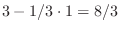 , again as we obtained before. Finally, it
must also be observed that the gain of the direct path from input to
output is
, again as we obtained before. Finally, it
must also be observed that the gain of the direct path from input to
output is  .
.
Next Section:
Matlab Direct-Form to State-Space Conversion
Previous Section:
Controllability and Observability