







Similarity Transformations
A similarity transformation is a linear change of coordinates.
That is, the original  -dimensional state vector
 is recast
in terms of a new coordinate basis. For any linear
transformation of the coordinate basis, the transformed state vector
is recast
in terms of a new coordinate basis. For any linear
transformation of the coordinate basis, the transformed state vector
 may be computed by means of a matrix multiply. Denoting the
matrix of the desired one-to-one linear transformation by
may be computed by means of a matrix multiply. Denoting the
matrix of the desired one-to-one linear transformation by  , we
can express the change of coordinates as
, we
can express the change of coordinates as

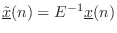 , if we prefer, since the inverse of a
one-to-one linear transformation always exists.
, if we prefer, since the inverse of a
one-to-one linear transformation always exists.
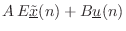
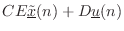
Let's now apply the linear transformation to the general
-dimensional state-space description in Eq. (G.1). Substituting
 in Eq.(G.1) gives
 |
 |
 |
|
 |
|
 |
(G.17) |
Premultiplying the first equation above by
 , we have
 |
|
 |
|
|
|
 |
(G.18) |
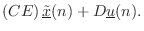
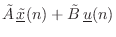
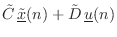
Defining


we can write
|
|
 |
|
|
|
 |
(G.20) |
The transformed system describes the same system as in Eq.
(G.1)
relative to new state-variable coordinates. To verify that it's
really the same system, from an input/output point of view, let's look
at the transfer function using
Eq.(G.5):
![\begin{eqnarray*}
{\tilde H}(z) &=& {\tilde D}+ {\tilde C}(zI - \tilde{A})^{-1}{...
...ht]^{-1} B\\
&=& D + C \left(zI - A\right)^{-1} B\\
&=& H(z)
\end{eqnarray*}](http://www.dsprelated.com/josimages_new/filters/img2172.png)
Since the eigenvalues of  are the poles of the system, it follows
that the eigenvalues of
are the poles of the system, it follows
that the eigenvalues of
 are the same. In other
words, eigenvalues are unaffected by a similarity transformation. We
can easily show this directly: Let
are the same. In other
words, eigenvalues are unaffected by a similarity transformation. We
can easily show this directly: Let
 denote an eigenvector of
. Then by definition
denote an eigenvector of
. Then by definition
 , where
  is the
eigenvalue corresponding to
. Define
is the
eigenvalue corresponding to
. Define
 as the
transformed eigenvector. Then we have
as the
transformed eigenvector. Then we have
 matrix, and the eigenvalue is unchanged.
The transformed Markov parameters,
 , are obviously
the same also since they are given by the inverse
, are obviously
the same also since they are given by the inverse  transform of the
transfer function
transform of the
transfer function
 . However, it is also easy to show this
by direct calculation:
. However, it is also easy to show this
by direct calculation:

Next Section:
Modal Representation
Previous Section:
Difference Equations to State Space












