State Space Simulation in Matlab
Since matlab has first-class support for matrices and vectors, it is quite simple to implement a state-space model in Matlab using no support functions whatsoever, e.g.,
% Define the state-space system parameters:
A = [0 1; -1 0]; % State transition matrix
B = [0; 1];  C = [0 1];  D = 0; % Input, output, feed-around

% Set up the input signal, initial conditions, etc.
x0 = [0;0];             % Initial state (N=2)
Ns = 10; 	        % Number of sample times to simulate
u = [1, zeros(1,Ns-1)]; % Input signal (an impulse at time 0)
y = zeros(Ns,1);        % Preallocate output signal for n=0:Ns-1

% Perform the system simulation:
x = x0;                % Set initial state
for n=1:Ns-1           % Iterate through time
  y(n) = C*x + D*u(n); % Output for time n-1
  x = A*x + B*u(n);    % State transitions to time n
end
y' % print the output y (transposed)
% ans =
%  0   1   0  -1   0   1   0  -1   0   0
The restriction to indexes beginning at 1 is unwieldy here, because we want to include time
 in the input and output. It can be readily
checked that the above examples has the transfer function
in the input and output. It can be readily
checked that the above examples has the transfer function
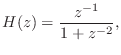
NUM = [0 1];
DEN = [1 0 1];
y = filter(NUM,DEN,u)
% y =
%   0   1   0  -1   0   1   0  -1   0   1
To eliminate the unit-sample delay, i.e., to simulate
 in state-space form, it is necessary to use the
  (feed-around) coefficient:
[A,B,C,D] = tf2ss([1 0 0], [1 0 1])
% A =
%    0   1
%   -1  -0
%
% B =
%   0
%   1
%
% C =
%   -1   0
%
% D = 1

x = x0;                % Reset to initial state
for n=1:Ns-1
  y(n) = C*x + D*u(n);
  x = A*x + B*u(n);
end
y'
% ans =
%  1   0  -1   0   1   0  -1   0   1   0
Note the use of trailing zeros in the first argument of tf2ss (the transfer-function numerator-polynomial coefficients) to make it the same length as the second argument (denominator coefficients). This is necessary in tf2ss because the same function is used for both the continous- and discrete-time cases. Without the trailing zeros, the numerator will be extended by zeros on the left, i.e., ``right-justified'' relative to the denominator.
Next Section:
Other Relevant Matlab Functions
Previous Section:
Matlab Direct-Form to State-Space Conversion