Step-Down Procedure
Let  denote the
  th-order denominator polynomial of the
recursive filter transfer function
th-order denominator polynomial of the
recursive filter transfer function
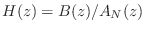 :
:

We have introduced the new subscript
because the step-down
procedure is defined recursively in polynomial order. We will need to
keep track of polynomials orders between 1 and .
In addition to the denominator polynomial , we need its
flip:




The recursion begins by setting the
th reflection coefficient to
 . If
. If
 , the recursion halts
prematurely, and the filter is declared unstable. (Equivalently, the
polynomial is declared non-minimum phase, as defined in
Chapter 11.)
, the recursion halts
prematurely, and the filter is declared unstable. (Equivalently, the
polynomial is declared non-minimum phase, as defined in
Chapter 11.)
Otherwise, if
 , the polynomial order is decremented by 1
to yield
, the polynomial order is decremented by 1
to yield
 as follows (recall that is
monic):
as follows (recall that is
monic):

Next  is set to
 , and the recursion continues
until
, and the recursion continues
until
 is reached, or
 is found for some
 .
.
Whenever
 , the recursion halts prematurely, and the
filter is usually declared unstable (at best it is marginally
stable, meaning that it has at least one pole on the unit
circle).
, the recursion halts prematurely, and the
filter is usually declared unstable (at best it is marginally
stable, meaning that it has at least one pole on the unit
circle).
Note that the reflection coefficients can also be used to implement the digital filter in what are called lattice or ladder structures [48]. Lattice/ladder filters have superior numerical properties relative to direct-form filter structures based on the difference equation. As a result, they can be very important for fixed-point implementations such as in custom VLSI or low-cost (fixed-point) signal processing chips. Lattice/ladder structures are also a good point of departure for computational physical models of acoustic systems such as vibrating strings, wind instrument bores, and the human vocal tract [81,16,48].
Next Section:
Testing Filter Stability in Matlab
Previous Section:
Computing Reflection Coefficients to Check Filter Stability