Superposition:
When two signals are added together and fed to the filter, the filter output is the same as if one had put each signal through the filter separately and then added the outputs (the superposition property).
While the implications of linearity are far-reaching, the mathematical definition is simple. Let us represent the general linear (but possibly time-varying) filter as a signal operator:
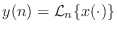
where
 is the entire input signal,
  is the output at
time
is the output at
time  , and
, and
 is the filter expressed as a real-valued
function of a signal for each . Think of the subscript on
as selecting the th output sample of the filter. In general,
each output sample can be a function of several or even
all input samples, and this is why we write as the
filter input.
is the filter expressed as a real-valued
function of a signal for each . Think of the subscript on
as selecting the th output sample of the filter. In general,
each output sample can be a function of several or even
all input samples, and this is why we write as the
filter input.
Definition. A filter
 is said to be
linear
if for any pair of signals
is said to be
linear
if for any pair of signals
 and for all
constant gains
and for all
constant gains  , we have the following relation for each
sample time
, we have the following relation for each
sample time
 :
:




where
 denotes the signal space (complex-valued sequences, in
general). These two conditions are simply a mathematical restatement of the
previous descriptive definition.
denotes the signal space (complex-valued sequences, in
general). These two conditions are simply a mathematical restatement of the
previous descriptive definition.
The scaling property of linear systems states that scaling the input of a linear system (multiplying it by a constant gain factor) scales the output by the same factor. The superposition property of linear systems states that the response of a linear system to a sum of signals is the sum of the responses to each individual input signal. Another view is that the individual signals which have been summed at the input are processed independently inside the filter--they superimpose and do not interact. (The addition of two signals, sample by sample, is like converting stereo to mono by mixing the two channels together equally.)
Another example of a linear signal medium is the earth's atmosphere. When two sounds are in the air at once, the air pressure fluctuations that convey them simply add (unless they are extremely loud). Since any finite continuous signal can be represented as a sum (i.e., superposition) of sinusoids, we can predict the filter response to any input signal just by knowing the response for all sinusoids. Without superposition, we have no such general description and it may be impossible to do any better than to catalog the filter output for each possible input.
Linear operators distribute over linear combinations, i.e.,

 , any real or complex signals
 , and any real or complex constant gain factors
 .
.
Next Section:
Real Linear Filtering of Complex Signals
Previous Section:
Scaling: