Symmetric Linear-Phase Filters
As stated at the beginning of this chapter, the impulse response of every causal, linear-phase, FIR filter is symmetric:

 is odd. Then the filter


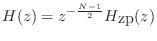

 which is real.
Since
can go negative, the phase response is
which is real.
Since
can go negative, the phase response is
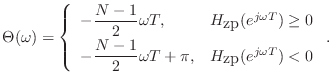
 at which
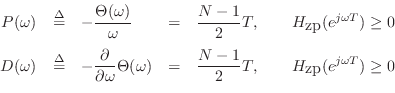
is nonnegative, the phase delay and group
delay of a linear-phase filter are simply half its length:
at which
is nonnegative, the phase delay and group
delay of a linear-phase filter are simply half its length:
Simple Linear-Phase Filter Examples
- The example of §10.2.1 was in fact a linear-phase FIR
filter design example. The resulting causal finite impulse response
was left-shifted (``advanced'' in time) to make it zero phase.
- While the trivial ``bypass filter''
 is zero-phase
(§10.2.2), the ``bypass filter with a unit delay,''
is zero-phase
(§10.2.2), the ``bypass filter with a unit delay,''
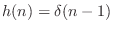 is linear phase. It is (trivially) symmetric
about time
is linear phase. It is (trivially) symmetric
about time  , and the frequency response is
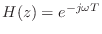 , which
is a pure linear phase term
, which
is a pure linear phase term
 having a slope
of
having a slope
of  samples (radians per radians-per-sample), or
  seconds
(radians per radians-per-second). The phase- and group-delays are
each 1 sample at every frequency.
seconds
(radians per radians-per-second). The phase- and group-delays are
each 1 sample at every frequency.
- The impulse response of the simplest lowpass filter studied in
Chapter 1 was
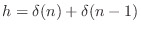 [
[
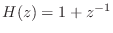 ].
Since this impulse response is symmetric about time
].
Since this impulse response is symmetric about time  samples,
it is linear phase, and
samples,
it is linear phase, and
 , as derived
in Chapter 1. The phase delay and group delay are both
, as derived
in Chapter 1. The phase delay and group delay are both  sample at
each frequency. Note that even-length linear-phase filters cannot be
time-shifted (without interpolation) to create a corresponding
zero-phase filter. However, they can be shifted to make a
near-zero-phase filter that has a phase delay and group delay equal to
half a sample at all passband frequencies.
sample at
each frequency. Note that even-length linear-phase filters cannot be
time-shifted (without interpolation) to create a corresponding
zero-phase filter. However, they can be shifted to make a
near-zero-phase filter that has a phase delay and group delay equal to
half a sample at all passband frequencies.
Software for Linear-Phase Filter Design
The Matlab Signal Processing Toolbox covers many applications with the following functions:
![$\displaystyle \begin{tabular}{rl}
\texttt{remez()} & (optimal Chebyshev linear-...
...or general FIR (or IIR)\\
& filter design \cite[page 50]{JOST}).
\end{tabular}$](http://www.dsprelated.com/josimages_new/filters/img1217.png)
Methods for FIR filter design are discussed in the fourth book of the music signal processing series [87], and classic references include [64,68]. There is also quite a large research literature on this subject.
Next Section:
Antisymmetric Linear-Phase Filters
Previous Section:
Odd Impulse Reponses