Time-Invariant Filters
In plain terms, a time-invariant
filter (or shift-invariant
filter) is one which performs the
same operation at all times. It is awkward to express this
mathematically by restrictions on Eq. (4.2) because of the use of
 as the symbol for the filter input. What we want to say is
that if the input signal is delayed (shifted) by, say,
as the symbol for the filter input. What we want to say is
that if the input signal is delayed (shifted) by, say,  samples,
then the output waveform is simply delayed by samples and
unchanged otherwise. Thus
samples,
then the output waveform is simply delayed by samples and
unchanged otherwise. Thus  , the output waveform from a
time-invariant filter, merely shifts forward or backward in
time as the input waveform is shifted forward or backward
in time.
, the output waveform from a
time-invariant filter, merely shifts forward or backward in
time as the input waveform is shifted forward or backward
in time.
Definition. A digital filter
 is said to be
time-invariant
if, for every input signal
is said to be
time-invariant
if, for every input signal  , we have
 SHIFT
SHIFT



where the
-sample shift operator is defined by
SHIFT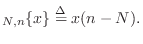
On the signal level, we can write
SHIFT
Thus,
SHIFT
 denotes the waveform shifted right
(delayed) by samples. The most common notation in the literature
for
SHIFT is
denotes the waveform shifted right
(delayed) by samples. The most common notation in the literature
for
SHIFT is  , but this can be misunderstood (if
  is not interpreted as `
 '), so it will be avoided here.
Note that Eq.(4.5) can be written on the waveform level instead
of the sample level as
'), so it will be avoided here.
Note that Eq.(4.5) can be written on the waveform level instead
of the sample level as
 SHIFT
SHIFT SHIFT
SHIFT SHIFT
SHIFT
Next Section:
Showing Linearity and Time Invariance, or Not
Previous Section:
Linear Filters