Two-Zero
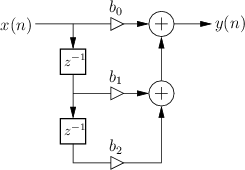
The signal flow graph for the general two-zero filter is given in Fig.B.7, and the derivation of frequency response is as follows:
![\fbox{
\begin{tabular}{rl}
Difference equation: & $y(n) = b_0 x(n) + b_1 x(n-1) ...
...+ b_1 \cos(\omega T) + b_2 \cos(2\omega T)}\right]$
\end{tabular}\vspace{10pt}
}](http://www.dsprelated.com/josimages_new/filters/img1389.png)
 .
.
As discussed in §5.1,
the parameters  and
and  are called the numerator
coefficients, and they determine the two zeros. Using the
quadratic formula for finding the roots of a second-order polynomial,
we find that the zeros are located at
are called the numerator
coefficients, and they determine the two zeros. Using the
quadratic formula for finding the roots of a second-order polynomial,
we find that the zeros are located at

 ], then the two-zero case
reduces to two instances of our earlier analysis for the
one-zero. Assuming the zeros to be complex, we may express the zeros
in polar form as
], then the two-zero case
reduces to two instances of our earlier analysis for the
one-zero. Assuming the zeros to be complex, we may express the zeros
in polar form as
 and
and
 , where
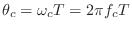 .
.
Forming a general two-zero transfer function in factored form gives
![\begin{eqnarray*}
H(z) &=& b_0 (1 - Re^{j\theta_c} z^{-1}) (1 - Re^{-j\theta_c} z^{-1})\\
&=& b_0 [1 - 2R\cos(\theta_c) z^{-1}+ R^2 z^{-2}]
\end{eqnarray*}](http://www.dsprelated.com/josimages_new/filters/img1397.png)
from which we identify
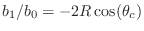 and
and
 , so that
![$\displaystyle y(n) = b_0\{ x(n) - [2R \cos(\theta_c)]x(n - 1) + R^2 x(n - 2)\}
$](http://www.dsprelated.com/josimages_new/filters/img1400.png)
 , is now viewed as a notch
frequency, or antiresonance frequency. The closer R is to 1,
the narrower the notch centered at
, is now viewed as a notch
frequency, or antiresonance frequency. The closer R is to 1,
the narrower the notch centered at  .
.
The approximate relation between bandwidth and  given in
Eq.
given in
Eq. (B.5) for the two-pole resonator now applies to the notch
width in the two-zero filter.
(B.5) for the two-pole resonator now applies to the notch
width in the two-zero filter.
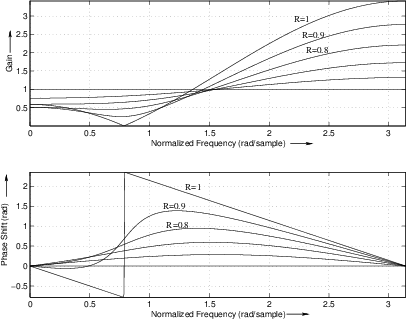
Figure B.8 gives some two-zero frequency responses obtained by
setting  to 1 and varying . The value of
  , is again
 . Note that the response is exactly analogous to the two-pole
resonator with notches replacing the resonant peaks. Since the plots
are on a linear magnitude scale, the two-zero amplitude response
appears as the reciprocal of a two-pole response. On a dB scale, the
two-zero response is an upside-down two-pole response.
. Note that the response is exactly analogous to the two-pole
resonator with notches replacing the resonant peaks. Since the plots
are on a linear magnitude scale, the two-zero amplitude response
appears as the reciprocal of a two-pole response. On a dB scale, the
two-zero response is an upside-down two-pole response.
 |

Next Section:
Complex Resonator
Previous Section:
Two-Pole