Unstable Poles--Unit Circle Viewpoint
We saw in §8.4 that an LTI filter is stable if and only
if all of its poles are strictly inside the unit circle ( ) in
the complex
) in
the complex  plane. In particular, a pole
  outside the unit
circle (
outside the unit
circle ( ) gives rise to an impulse-response component
proportional to
) gives rise to an impulse-response component
proportional to  which grows exponentially over time
  . We
also saw in §6.2 that the z transform of a growing exponential does
not not converge on the unit circle in the plane. However, this
was the case for a causal exponential
. We
also saw in §6.2 that the z transform of a growing exponential does
not not converge on the unit circle in the plane. However, this
was the case for a causal exponential  , where
  is the unit-step function (which switches from 0 to 1 at time 0). If
the same exponential is instead anticausal, i.e., of the form
is the unit-step function (which switches from 0 to 1 at time 0). If
the same exponential is instead anticausal, i.e., of the form
 , then, as we'll see in this section, its z transform does exist on
the unit circle, and the pole is in exactly the same place as in the
causal case. Therefore,to unambiguously invert a z transform, we must know
its region of convergence. The critical question is whether
the region of convergence includes the unit circle: If it does, then
each pole outside the unit circle corresponds to an anticausal, finite
energy, exponential, while each pole inside corresponds to the usual
causal decaying exponential.
, then, as we'll see in this section, its z transform does exist on
the unit circle, and the pole is in exactly the same place as in the
causal case. Therefore,to unambiguously invert a z transform, we must know
its region of convergence. The critical question is whether
the region of convergence includes the unit circle: If it does, then
each pole outside the unit circle corresponds to an anticausal, finite
energy, exponential, while each pole inside corresponds to the usual
causal decaying exponential.
Geometric Series
The essence of the situation can be illustrated using a simple
geometric series. Let  be any real (or complex) number. Then we
have
be any real (or complex) number. Then we
have
 when
when
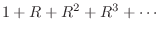 is
guaranteed to be summable when
is
guaranteed to be summable when  , and in that case, the sum is
given by
, and in that case, the sum is
given by  . On the other hand, if
  , we can rewrite
as
, we can rewrite
as
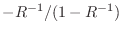 to obtain
![$\displaystyle \frac{1}{1-R} \eqsp \frac{-R^{-1}}{1-R^{-1}}
\eqsp -R^{-1}\left[1 + R^{-1} + R^{-2} + R^{-3} + \cdots \right]
$](http://www.dsprelated.com/josimages_new/filters/img1083.png) . Thus, is a valid
closed-form sum whether or not
. Thus, is a valid
closed-form sum whether or not  is less than or greater than 1.
When , it is the sum of the causal geometric series in powers
of . When , it is the sum of the causal geometric series in
powers of
is less than or greater than 1.
When , it is the sum of the causal geometric series in powers
of . When , it is the sum of the causal geometric series in
powers of  , or, an anticausal geometric series in
(negative) powers of .
, or, an anticausal geometric series in
(negative) powers of .
One-Pole Transfer Functions
We can apply the same analysis to a one-pole transfer function.
Let
 denote any real or complex number:

 , or
, or  . For the
region of convergence to include the unit circle (our frequency axis),
we must have
. For the
region of convergence to include the unit circle (our frequency axis),
we must have  , which is our usual stability criterion for a
pole at
, which is our usual stability criterion for a
pole at  . The inverse z transform is then the causal decaying
sampled exponential
. The inverse z transform is then the causal decaying
sampled exponential

Now consider the rewritten case:
![\begin{eqnarray*}
\frac{1}{1-pz^{-1}} &=& \frac{-p^{-1}z}{1-p^{-1}z} \\
&=& -p^...
...cdots\right]\\
&\leftrightarrow& - u(-n-1)p^n,\quad n\in{\bf Z}
\end{eqnarray*}](http://www.dsprelated.com/josimages_new/filters/img1092.png)
where the inverse z transform is the inverse bilateral z transform. In this
case, the convergence criterion is
 , or
, or  , and
this region includes the unit circle when .
, and
this region includes the unit circle when .
In summary, when the region-of-convergence of the z transform is assumed to
include the unit circle of the plane, poles inside the unit circle
correspond to stable, causal, decaying exponentials, while poles
outside the unit circle correspond to anticausal exponentials that
decay toward time  , and stop before time zero.
Figure 8.8 illustrates the two types of exponentials (causal and anticausal) that correspond to poles (inside and outside the unit circle) when the z transform region of convergence is defined to include the unit circle.
myFourFiguresToWidthpolesout11polesout21polesout12polesout220.52Left column:
Causal exponential decay, pole at  . Right column: Anticausal
exponential decay, pole at
. Right column: Anticausal
exponential decay, pole at  . Top: Pole-zero diagram.
Bottom: Corresponding impulse response, assuming the region of
convergence includes the unit circle in the plane.
. Top: Pole-zero diagram.
Bottom: Corresponding impulse response, assuming the region of
convergence includes the unit circle in the plane.
Next Section:
Poles and Zeros of the Cepstrum
Previous Section:
Time Constant of One Pole