







Why Dynamic Range Compression is Nonlinear
We can model dynamic range compression as a level-dependent
gain. Multiplying a signal by a constant gain (``volume control''),
on the other hand, is a linear operation. Let's check that the
scaling and superposition properties of linear systems are satisfied
by a constant gain: For any signals  , and for any constants
 , we must have
![$\displaystyle g \cdot [\alpha \cdot x_1(n) + \beta \cdot x_2(n)] = \alpha \cdot [g \cdot x_1(n)]
+ \beta \cdot [g \cdot x_2(n)].
$](http://www.dsprelated.com/josimages_new/filters/img489.png)
 '' is used to indicate
multiplication.)
'' is used to indicate
multiplication.)
Dynamic range compression can also be seen as a time-varying
gain factor, so one might be tempted to classify it as a linear,
time-varying filter. However, this would be incorrect because the
gain  , which multiplies the input, depends on the input
signal
, which multiplies the input, depends on the input
signal  . This happens because the compressor must estimate the
current signal level in order to normalize it. Dynamic range
compression can be expressed symbolically as a filter of the form
. This happens because the compressor must estimate the
current signal level in order to normalize it. Dynamic range
compression can be expressed symbolically as a filter of the form
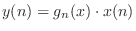
 denotes a gain that depends on the ``current level'' of
 at time
  . A common definition of signal level
is rms level (the ``root mean square'' [84, p. 75]
computed over a sliding time-window). Since many successive samples
of
. A common definition of signal level
is rms level (the ``root mean square'' [84, p. 75]
computed over a sliding time-window). Since many successive samples
of  are needed to estimate the current level, we cannot correctly
write
are needed to estimate the current level, we cannot correctly
write ![$ g[x(n)]$](http://www.dsprelated.com/josimages_new/filters/img492.png) for the gain function, although we could write
something like
for the gain function, although we could write
something like
![$ g[x(n-M\!:\!n)]$](http://www.dsprelated.com/josimages_new/filters/img493.png) (borrowing matlab syntax), where
(borrowing matlab syntax), where  is the number of past samples needed to estimate the current amplitude
level. In general,
is the number of past samples needed to estimate the current amplitude
level. In general,
![$\displaystyle g(x_1 + x_2)\cdot [x_1(n) + x_2(n)] \neq g(x_1) \cdot x_1(n) + g(x_2) \cdot x_2(n) .
$](http://www.dsprelated.com/josimages_new/filters/img494.png)
In general, any signal operation that includes a multiplication in which both multiplicands depend on the input signal can be shown to be nonlinear.
Next Section:
Convolution Representation Summary
Previous Section:
Series, Real, Second-Order Sections












