Bessel Functions
The Bessel functions of the first kind may be defined as the
coefficients
 in the two-sided Laurent expansion
of the so-called
generating function
[84, p. 14],4.10
in the two-sided Laurent expansion
of the so-called
generating function
[84, p. 14],4.10
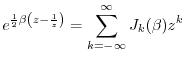
where
 is the integer order
of the Bessel function, and
is the integer order
of the Bessel function, and  is its argument (which
can be complex, but we will only consider real ).
Setting
is its argument (which
can be complex, but we will only consider real ).
Setting
 , where
  will interpreted as the
FM modulation frequency and
will interpreted as the
FM modulation frequency and  as time in seconds, we obtain
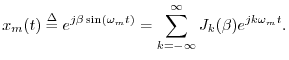
The last expression can be interpreted as the Fourier superposition of the sinusoidal harmonics of
![$ \exp[j\beta\sin(\omega_m t)]$](http://www.dsprelated.com/josimages_new/mdft/img528.png) , i.e., an
inverse Fourier series sum. In other words,
is
the amplitude of the th harmonic in the Fourier-series expansion of
the periodic signal
, i.e., an
inverse Fourier series sum. In other words,
is
the amplitude of the th harmonic in the Fourier-series expansion of
the periodic signal  .
.
Note that
is real when is real. This can be seen
by viewing Eq. (4.6) as the product of the series expansion for
![$ \exp[(\beta/2) z]$](http://www.dsprelated.com/josimages_new/mdft/img529.png) times that for
times that for
![$ \exp[-(\beta/2)/z]$](http://www.dsprelated.com/josimages_new/mdft/img530.png) (see footnote
pertaining to Eq.(4.6)).
(see footnote
pertaining to Eq.(4.6)).
Figure 4.15 illustrates the first eleven Bessel functions of the first
kind for arguments up to  . It can be seen in the figure
that when the FM index is zero,
. It can be seen in the figure
that when the FM index is zero,  and
and  for
all
for
all  . Since
 is the amplitude of the carrier
frequency, there are no side bands when
is the amplitude of the carrier
frequency, there are no side bands when  . As the FM index
increases, the sidebands begin to grow while the carrier term
diminishes. This is how FM synthesis produces an expanded, brighter
bandwidth as the FM index is increased.
. As the FM index
increases, the sidebands begin to grow while the carrier term
diminishes. This is how FM synthesis produces an expanded, brighter
bandwidth as the FM index is increased.
![\includegraphics[width=\twidth]{eps/bessel}](http://www.dsprelated.com/josimages_new/mdft/img537.png)
Next Section:
FM Spectra
Previous Section:
Example AM Spectra