Complex Roots
![\includegraphics[scale=0.5]{eps/parabola}](http://www.dsprelated.com/josimages_new/mdft/img139.png)
As a simple example, let  ,
,  , and
, and  , i.e.,
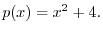
 (where
 ) and reaching upward to positive infinity, never going below
  .
It has no real zeros. On the other hand, the quadratic formula says that the
``roots'' are given formally by
.
It has no real zeros. On the other hand, the quadratic formula says that the
``roots'' are given formally by
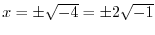 . The
square root of any negative number
. The
square root of any negative number  can be expressed as
 , so the only new algebraic object is
  .
Let's give it a name:
.
Let's give it a name:

 are
are  , and we can formally
express the polynomial in terms of its roots as
, and we can formally
express the polynomial in terms of its roots as


 and
and  are real numbers, and
 .
.
It can be checked that all algebraic operations for real
numbers2.2 apply equally well to complex numbers. Both real numbers
and complex numbers are examples of a
mathematical field.2.3 Fields are
closed with respect to multiplication and addition, and all the rules
of algebra we use in manipulating polynomials with real coefficients (and
roots) carry over unchanged to polynomials with complex coefficients and
roots. In fact, the rules of algebra become simpler for complex numbers
because, as discussed in the next section, we can always factor
polynomials completely over the field of complex numbers while we cannot do
this over the reals (as we saw in the example
 ).
).
Next Section:
Fundamental Theorem of Algebra
Previous Section:
The Quadratic Formula