Continuous-Time Aliasing Theorem
Let  denote any continuous-time signal having a Fourier
Transform (FT)
denote any continuous-time signal having a Fourier
Transform (FT)
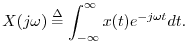
 at uniform intervals of
  seconds,
and denote its Discrete-Time Fourier Transform (DTFT) by
seconds,
and denote its Discrete-Time Fourier Transform (DTFT) by
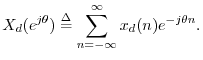
 of the sampled signal
  is related to the
spectrum
is related to the
spectrum  of the original continuous-time signal
  by
by
![$\displaystyle X_d(e^{j\theta}) = \frac{1}{T} \sum_{m=-\infty}^\infty X\left[j\left(\frac{\theta}{T}
+ m\frac{2\pi}{T}\right)\right].
$](http://www.dsprelated.com/josimages_new/mdft/img1788.png)
 are called aliasing
terms. They are said to alias into the base band
are called aliasing
terms. They are said to alias into the base band
![$ [-\pi/T,\pi/T]$](http://www.dsprelated.com/josimages_new/mdft/img1790.png) . Note that the summation of a spectrum with
aliasing components involves addition of complex numbers; therefore,
aliasing components can be removed only if both their amplitude
and phase are known.
. Note that the summation of a spectrum with
aliasing components involves addition of complex numbers; therefore,
aliasing components can be removed only if both their amplitude
and phase are known.
Proof:
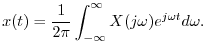
Writing as an inverse FT gives
 as an inverse DTFT gives
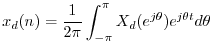
 denotes the normalized discrete-time
frequency variable.
denotes the normalized discrete-time
frequency variable.
The inverse FT can be broken up into a sum of finite integrals, each of length
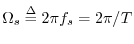 , as follows:
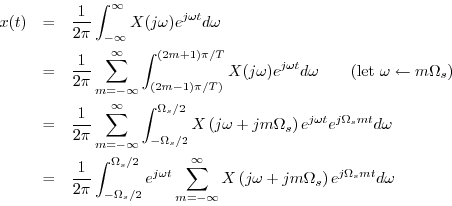
Let us now sample this representation for at  to obtain
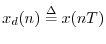 , and we have
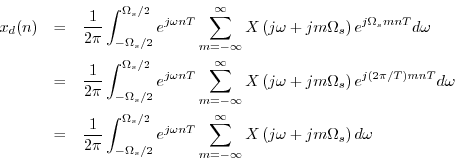
since  and
and  are integers.
Normalizing frequency as
are integers.
Normalizing frequency as
 yields
![$\displaystyle x_d(n) = \frac{1}{2\pi}\int_{-\pi}{\pi} e^{j\theta^\prime n}
\f...
...t(\frac{\theta^\prime }{T}
+ m\frac{2\pi}{T}\right) \right] d\theta^\prime .
$](http://www.dsprelated.com/josimages_new/mdft/img1800.png)
 written in terms of
 ,
the result follows.
,
the result follows.

Next Section:
Changing the Base
Previous Section:
Reconstruction from Samples--The Math