Sign in

username:

password:


Not a member?

Search Online Books


Search tips

Free Online Books


Chapters

See Also

Embedded SystemsFPGAElectronics
Chapter Contents:

Search Mathematics of the DFT


Book Index | Global Index


Would you like to be notified by email when Julius Orion Smith III publishes a new entry into his blog?


Decimation in Time

The DFT is defined by

$\displaystyle X(k) = \sum_{n=0}^{N-1} x(n) W_N^{kn}, \quad k=0,1,2,\ldots,N-1,
$

where $ x(n)$ is the input signal amplitude at time $ n$, and

$\displaystyle W_N \isdef e^{-j\frac{2\pi}{N}}.\quad \hbox{(primitive $N$th root of unity)}
$

Note that $ W_N^N=1$.

When $ N$ is even, the DFT summation can be split into sums over the odd and even indexes of the input signal:

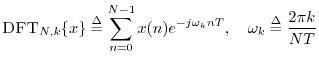
$\displaystyle X(\omega_k)$ $\displaystyle \isdef$ $\displaystyle \hbox{\sc DFT}_{{N,k}}\{x\} \isdef \sum_{n=0}^{N-1} x(n) e^{-j\omega_k n T},
\quad \omega_k \isdef \frac{2\pi k}{NT}$  
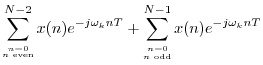
  $\displaystyle =$ $\displaystyle \sum_{{\stackrel{n=0}{\vspace{2pt}\mbox{\tiny$n$\ even}}}}^{N-2} ...
...stackrel{n=0}{\vspace{2pt}\mbox{\tiny$n$\ odd}}}}^{N-1} x(n) e^{-j\omega_k n T}$  
  $\displaystyle =$ $\displaystyle \sum_{n=0}^{\frac{N}{2}-1} x(2n) e^{-j2\pi \frac{k}{N/2} n}
+ e^{-j2\pi\frac{k}{N}}\sum_{n=0}^{\frac{N}{2}-1} x(2n+1) e^{-j2\pi \frac{k}{N/2} n},$  
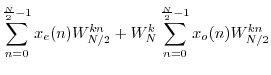
  $\displaystyle =$ $\displaystyle \sum_{n=0}^{\frac{N}{2}-1} x_e(n) W_{N/2}^{kn} + W_N^k
\sum_{n=0}^{\frac{N}{2}-1} x_o(n) W_{N/2}^{kn}$  
  $\displaystyle \isdef$ $\displaystyle \hbox{\sc DFT}_{{\frac{N}{2},k}}\{\hbox{\sc Downsample}_2(x)\}$  
    $\displaystyle \mathop{\quad} +\;W_N^k\cdot\hbox{\sc DFT}_{{\frac{N}{2},k}}\{\hbox{\sc Downsample}_2[\hbox{\sc Shift}_1(x)]\},
\protect$ (A.1)

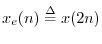
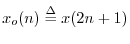
where $ x_e(n)\isdef x(2n)$ and $ x_o(n)\isdef x(2n+1)$ denote the even- and odd-indexed samples from $ x$. Thus, the length $ N$ DFT is computable using two length $ N/2$ DFTs. The complex factors $ W_N^k=e^{-j\omega_k}=\exp(-j2\pi k/N)$ are called twiddle factors. The splitting into sums over even and odd time indexes is called decimation in time. (For decimation in frequency, the inverse DFT of the spectrum $ X(\omega_k)$ is split into sums over even and odd bin numbers $ k$.)


Order a Hardcopy of Mathematics of the DFT

Previous: Mixed-Radix Cooley-Tukey FFT
Next: Radix 2 FFT

written by Julius Orion Smith III
Julius Smith's background is in electrical engineering (BS Rice 1975, PhD Stanford 1983). He is presently Professor of Music and Associate Professor (by courtesy) of Electrical Engineering at Stanford's Center for Computer Research in Music and Acoustics (CCRMA), teaching courses and pursuing research related to signal processing applied to music and audio systems. See http://ccrma.stanford.edu/~jos/ for details.


Comments


No comments yet for this page


Add a Comment
You need to login before you can post a comment (best way to prevent spam). ( Not a member? )